How to Bring Tropical Architecture into the Spaces That Need It Most
The phrase "artificial palm tree for outdoors" gets searched thousands of times a month, and almost every result misreads the intent. People are not asking for a palm tree to plant in a desert. They are asking for a palm tree that earns its place on a covered patio, in a sunroom, beside a pool cabana, or under a pergola. The space already exists. They are looking for the structure to anchor it. That distinction matters. An artificial palm tree for outdoors does not need to survive direct sun and storms to do its job. It needs to read as architectural in a transitional space, the kind of space that lives between indoors and out, where the design rules of both apply.
Why Palms Are Having a Cultural Moment Again

Tropical design is back, but it has matured. The conversation has shifted from kitsch to architecture. Better Homes & Gardens has covered the resurgence of leaf-driven decor as a defining 2026 trend, and the same publication has documented tropical chic as a serious aesthetic category rather than a summer novelty. Southern Home Magazine has traced how the palm tree became a timeless design motif in interiors around the world, grounding the palm not in fashion but in centuries of architectural tradition. House & Garden regularly features tropical design ideas in its editorial roundups, treating the look as part of the canon rather than a passing trend. The cultural cue is even more visible in private homes. Homes and Gardens recently profiled Eva Mendes's Mediterranean-style planting, which surrounds her Spanish revival home with bird of paradise, succulents and agave, and yellow hibiscus to make the front entry feel like a vacation. Bird of paradise specifically has become one of the defining tropical structures of the year, prized for its sculptural leaves and vertical posture. Agave has had a parallel rise as the desert counterpart: rosette-shaped, architectural, and at home in the same Mediterranean and Spanish revival contexts where palms also work. The instinct to live somewhere that feels like a vacation has crossed from aspiration into design discipline. Palms, bird of paradise, and agave are three of the cleanest ways to express it.
The Difference Between Outdoor and Covered Outdoor
Most online listings collapse "outdoor" into a single category, which is misleading. There is full-exposure outdoor (lawn, full sun, weather), and there is covered outdoor (porches, screened patios, breezeways, three-season rooms). These are two entirely different design contexts. Full-exposure outdoor is rarely where palm trees belong, real or faux. Live palms outside their native climate require constant care. Faux palms not engineered with UV protection will fade in direct sunlight, which is why CG Hunter currently specifies its trees for indoor and covered outdoor use only. What this actually unlocks is more useful: the covered patio, the sunroom, the conservatory, the sheltered porch. These spaces want the visual weight of a tropical tree without the maintenance that kills the styling.
Why a Palm Tree Reads as Architecture, Not Decoration

Trees are structural. A wreath softens a wall. A console arrangement balances a surface. A six- or seven-foot tree changes how the entire room is read, anchoring sightlines, defining corners, and giving vertical dimension to a horizontal plan. From a design perspective, a palm tree placed correctly in a covered outdoor space does the same work as a column or a beam. What separates a well-styled tropical space from a kitsch one is the discipline of the silhouette. A palm with overworked, overly glossy fronds reads as costume. A palm with correct proportion, varied frond color, and a clean trunk reads as botanical. The goal is the second one.
Five Tropical Anchors for Five Different Design Outcomes
CG Hunter's tropical and desert-adjacent category includes five pieces that each solve a distinct design problem. Featuring them here in the order most readers will encounter the choice.
The 7' Artificial Palm Tree is the classic move. At seven feet with 54 fronds and a slim 9.5" grower pot designed to drop into any decorative planter or basket, it is built for vertical impact in a corner, beside a pool entrance, or flanking a doorway on a covered patio. The grower pot detail is a designer's quiet advantage: it lets you change the planter to match the room rather than commit to one finish forever.
The 6' Artificial Fishtail Palm Tree in Pot solves a different problem. Fishtail palms have serrated, layered foliage and multiple slender trunks, which makes them softer and more sculptural than a standard palm. With 620 leaves and a wider 51" canopy, this tree reads as collected and full rather than singular and tall. It belongs in a sunroom where you want greenery that fills the upper register of the space without overwhelming the floorplan.
The 8' Bird of Paradise Tree is the editorial choice. Bird of paradise has the most architectural posture of any tropical tree, with broad, paddle-shaped leaves that fan upward rather than drape down. At eight feet, it is the tallest in the collection, which makes it the natural anchor for a double-height sunroom, a tall covered porch, or a pool house with vaulted ceilings. The modern gray planter is intentional: it lets the leaves do the styling work without competing for attention. This is the tree to choose when the goal is sculpture, not softness.
The 6' Artificial Yucca Tree is the honorable mention here, and worth knowing about for any reader whose covered outdoor space leans desert, southwestern, or modernist rather than tropical. The yucca's elongated, fanned leaves and clean architectural silhouette work where a frond-heavy palm would feel out of context. It is a palm-adjacent option for spaces that want sculptural greenery without the resort vocabulary.
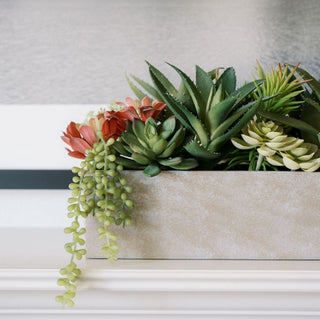
The 31.5" Artificial Agave Plant is the lower-register companion to all of the above. Where the trees handle the vertical, the agave handles the floor and tabletop scale: a tight rosette of thick, pointed leaves that reads as both Mediterranean and desert, depending on what surrounds it. Use it at the base of a palm to layer height, on a side table beside a sunroom seating area, or as a single sculptural object on a covered patio's stone floor. From the Hunter Collection, it is the piece that finishes the room when the trees alone leave the eye nowhere to land.
Where to Place Them

Start with the corner. Covered patios and sunrooms almost always have one underused corner that feels visually empty when the seating is full. A six- or seven-foot tree closes that gap and makes the seating area feel intentional. Flanking is the second move. Two trees on either side of a sliding door, an outdoor fireplace, or a pool entrance create the bilateral symmetry that reads as designed rather than decorated. Curated Sets are organized for pairings exactly like this. Avoid the floating placement. A single tree marooned in the middle of a wall, untethered to furniture or architecture, reads as filler. Trees need a relationship to something: a chair, a sofa arm, a window frame, a planter cluster. Anchor first, then style.
Pots, Planters, and the Detail Most People Get Wrong
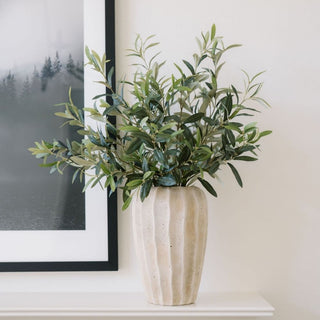
A faux tree is only as convincing as its base. The most common mistake on covered patios is leaving a grower pot fully visible. The fix is straightforward: drop the grower pot into a heavier decorative planter (concrete, glazed terracotta, woven rattan, ribbed stone) that matches the material vocabulary of the rest of the patio. The 7' Palm Tree's 9.5" grower pot is sized to fit standard planters, which makes this swap easy. The tree should look as if it belongs to the room, not as if it was carried in from a delivery truck. A planter does that work.
Care, Care Myths, and Realistic Expectations

Faux palm trees in covered outdoor settings are nearly maintenance-free. A feather duster, a soft microfiber cloth, or a hairdryer on a cool setting handles most upkeep. A damp cloth wipes deeper buildup off individual fronds. None of this is a chore, especially compared to the watering and trimming a real palm would demand even in the right climate. The honest caveat: the current CG Hunter palm trees are not engineered for direct sunlight or severe weather. Full-exposure outdoor placement, unprotected from sun and wind, will cause fading and damage over time. The right framing is that they thrive in the protected outdoor spaces most homeowners actually use, which is also where most homeowners actually want them.
What Is Coming Next: UV-Protected Outdoor Palms
Reader demand for true full-sun outdoor faux trees has been clear, and CG Hunter is responding to it. The product line is being expanded to include UV-protected palm trees specifically engineered for direct sunlight and full-exposure outdoor use, which will open up patios, pool decks, and uncovered courtyards as legitimate placement options. That collection is in development and will be announced in the Designer Journal when it launches. For now, the recommendation remains covered outdoor placement, which still covers the majority of how these trees are actually used in homes.
Designer Answers: All About the Palm

Q: Can artificial palm trees be used outdoors?
A: Yes, in covered outdoor spaces. CG Hunter palm trees are currently designed for indoor and covered outdoor use, including porches, sunrooms, screened patios, and pool cabanas, as long as they are protected from direct sunlight and severe weather. A UV-protected outdoor collection is in development for full-exposure use.
Q: What is the most realistic faux palm tree for a sunroom?
A: For a sunroom, the 6' Artificial Fishtail Palm Tree is often the best fit because its serrated leaves and multiple slender trunks read as full and collected without dominating the space. The 7' Artificial Palm Tree is the better choice when vertical impact is the priority, and the 8' Bird of Paradise Tree is the choice for tall ceilings and a more sculptural silhouette.
Q: Do artificial palm trees fade outdoors?
A: They can, when placed in direct sun without UV protection. The current CG Hunter palm trees are not UV-rated, which is why placement under cover (a roof, a pergola, a porch overhang, a sunroom) is the recommended approach. UV-protected versions are being added to the line for direct-sun placement.
Q: How tall should an outdoor faux palm tree be?
A: Most covered outdoor spaces benefit from a six- to eight-foot tree. Anything shorter tends to read as a houseplant rather than an architectural element. For taller ceilings, two trees flanking an opening often work better than one, or a single eight-foot bird of paradise can hold the space alone.
Q: What about a yucca tree instead of a palm?
A: A yucca is a strong alternative for covered outdoor spaces with a southwestern, desert, or modernist design language. It offers the same vertical sculptural quality without the tropical vocabulary, which can help in homes where a palm would feel out of context.
Q: How do I style an agave plant in a tropical or Mediterranean room?
A: An agave plant works at the floor or tabletop scale where the trees do not reach. Place it at the base of a taller tree to layer height, beside a seating arrangement to ground a corner, or as a single sculptural object on a covered patio. Its rosette form bridges Mediterranean, Spanish revival, and desert design vocabularies, which makes it one of the most versatile faux pieces in a tropical room.
The Quiet Power of a Well-Placed Tree
A palm tree on a covered patio is not a vacation prop. It is a structural decision that tells the eye where the space ends and how it should be read. The right tree, in the right scale, in the right relationship to the architecture, does the same work as a column or a sightline. The wrong one does nothing at all. The difference is intention. For more on how greenery functions as architecture, visit the Designer Journal, follow our Substack for weekly design notes, and find us at @cghunterhome on Instagram, Pinterest, and TikTok.