The case for a faux olive tree as the most considered thing you can add to your home this April
Earth Day falls on April 22 every year, and it started exactly where most lasting ideas do: with one person deciding the moment called for something more intentional. Wisconsin Senator Gaylord Nelson organized the first Earth Day in 1970 after environmental activism of the 1960s convinced him the movement needed a national moment. Twenty million people showed up. More than fifty years later, the occasion has become less about spectacle and more about the smaller, quieter decisions that compound over time.
That shift in thinking, from grand gesture to considered habit, is also what drives the case for faux greenery in the home.
The Sustainability Argument for Faux Trees

A live olive tree indoors requires specific humidity, light exposure, and consistent watering. Most do not survive a full year in a typical home environment. The cycle of buying, losing, and replacing live plants is rarely examined for what it actually is: a pattern of waste dressed up as nature-connectedness.
As Homes and Gardens noted in their Earth Day 2026 editorial, the more sustainable choice is often the considered one, pieces chosen for longevity rather than impulse, and lived with for years rather than seasons. A faux olive tree, placed well and chosen for quality, is not a compromise. It is a structural decision that holds.
Why the Olive Tree Specifically
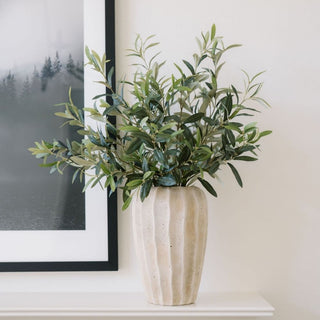
The olive tree earns its place in design on its own terms. The silvery-green foliage reads as both neutral and alive. The branching structure is irregular in the way that real trees are, not symmetrical in the way that manufactured things tend to be. It works in a corner that needs vertical interest, beside a console that reads as too flat, or flanking a fireplace where two trees give a room a sense of formal ease without formality.
It also ages well visually. Unlike trend-forward plants that feel tied to a particular moment, the olive tree is a constant. Mediterranean in origin, ancient in association, and quietly architectural in almost any interior context.
Choosing the Right Size for Your Space

Scale matters more than most people account for when they choose a tree. A smaller tree in a large room does not read as restrained; it reads as under-considered. The faux olive tree collection at CG Hunter spans a range of heights precisely because the 4' version belongs in a different room than the 7'. A bedroom benefits from something lower, something that occupies the periphery without demanding attention. A living room with high ceilings can support a tree that earns a second look from across the room.
If the intention is to use two trees together, that pairing changes the equation. Two trees of the same height flanking a fireplace or doorway function architecturally in a way a single tree cannot. Curated Sets are available for pairings like this, which makes the decision simpler from the start.
Beyond the Olive: Faux Trees Worth Knowing
The olive tree is the most requested, but it is not the only one doing serious design work. The best sellers collection includes faux trees that span a wider range of scale, silhouette, and room type. A ficus brings density and a fuller canopy to spaces that need more visual weight. A fiddle leaf fig commands a corner with the kind of vertical authority that smaller plants cannot achieve. A cedar or cypress reads as more architectural, useful in entryways or alongside built-ins where the tree functions more as structure than as softness. The common thread across all of them is that none of these are decorative afterthoughts. Each one changes the proportion of a room in a way that furniture alone cannot. If the olive tree is not the right fit for your space, the answer is likely in the same collection.
Earth Day Is the Right Moment to Do This Correctly

Starting April 22, faux trees at CG Hunter are 25% off. That is not a reason to buy something you do not need. It is a reason to do correctly what you were already going to do. If your space has needed a tree for months, and most rooms that feel slightly unresolved do, this is the prompt to stop deferring and make the choice that holds.
The Earth Day premise has always been that small, deliberate decisions accumulate into something larger. Choosing a faux olive tree over a live one that will not survive the year is, in its way, exactly that kind of decision.
Find More on the Designer Journal and Beyond
For more on how faux greenery functions as architecture in the home, the Designer Journal covers placement, proportion, and styling in depth. New posts publish weekly on Substack. For daily design reference, follow @cghunterhome on Instagram, Pinterest, and TikTok.