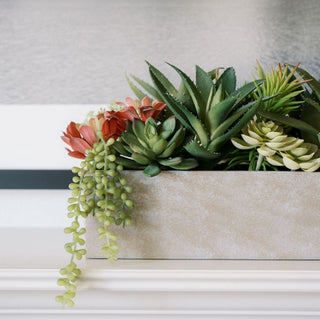
Where thoughtful material choices meet spaces that actually get lived in
The conversation around faux plants has shifted. For years, the default assumption was that choosing artificial greenery over live plants was a concession, a trade-off made for convenience at the expense of aesthetic credibility. That framing no longer holds. In 2026, the designers and homeowners making the most considered spaces are treating faux botanicals as a deliberate material choice, the same way they approach a stone countertop or a linen sofa. The question has moved from "real or faux?" to "which piece, and where."
The Design Case for Faux Has Never Been Stronger

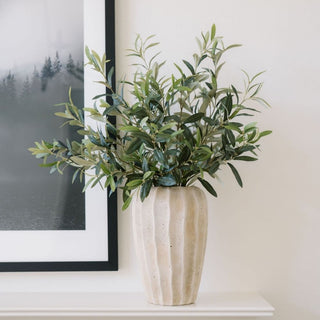
What changed is not the quality argument, though quality has improved significantly. What changed is the design philosophy behind the choice. Faux plants earn their place in a room not because they require no watering, but because the right piece holds its form, scale, and presence across every season without requiring the room to reorganize around it. A well-chosen faux olive tree in a reading corner does not drop leaves in winter. It does not demand a particular light source. It stays exactly where you placed it, doing exactly what it was placed to do: anchor the corner, add organic texture, and give the room a vertical element that furniture alone cannot provide.
From a design perspective, that kind of reliability is structural. It is not laziness. It is intention.
Faux Plants Work the Way Good Furniture Works
The most useful comparison is not to live plants at all. It is to furniture. No one apologizes for buying a sofa that does not transform seasonally. No one expects a console table to require weekly attention. The pieces that hold a room together are the ones that stay. Faux botanicals, chosen at the right scale and with the right material quality, operate exactly like that. They are part of the architecture of a space, not an accessory layered on top of it.
This is why scale matters more than almost anything else when selecting faux greenery. A small stem in a large living room disappears. An appropriately scaled tree in a corner commands the space with the same weight as a well-placed floor lamp or a substantial chair. The room reads differently. It settles.
What 2026 Gets Right About Restraint

The broader design movement of this moment is away from density and toward clarity. Homes that photograph well are not always homes that feel good to occupy, and that gap has become more visible. Over-styled rooms, those with a surface for every object and an object for every surface, have started to feel like effort rather than ease. What holds up in real homes is a simpler framework: fewer pieces, each doing more.
Faux botanicals fit that framework particularly well. One considered tree does more for a room than three smaller plants clustered together. A single large-leaf variety on a dining credenza shifts the entire visual register of the room. The restraint is the point. If you are looking to add life to a space without adding complexity, a single strong faux plant is often the most precise tool available. For styling guidance on placement and proportion, our post on Making the Most of Your Faux Plants is a useful starting point, as is our piece on Avoiding Common Faux Plant Mistakes, which addresses the errors that tend to undercut even a good selection.
The Sustainability Argument Has Matured
In earlier conversations about faux versus live, sustainability was often framed as a point against artificial plants. That framing was too simple. A quality faux plant purchased once and kept for a decade does not generate the ongoing waste of plants bought, replaced, or discarded seasonally. It does not require pesticides, imported soil amendments, or the water overhead that some live varieties demand. The sustainability case for faux is not absolute, but it is more nuanced and more honest than it was five years ago. Our piece Going Green: Why Faux Plants Are the Coolest and Most Sustainable Home Decor Trend covers this in more depth for anyone thinking through that side of the decision.
A Note on Spring, and the Spaces That Matter

Spring is when the impulse to refresh a space is strongest, and Mother's Day tends to accelerate that instinct in a particular direction. Faux botanicals are one of the few gift categories that translate directly into a design decision for the recipient's home. A piece chosen at the right scale for the right room is not a seasonal gesture. It is a permanent addition to how that space looks and feels. For those navigating how to introduce faux plants into rooms where live plants have typically felt too demanding, our guide on decorating a bathroom with faux plants demonstrates the approach in one of the most practically challenging rooms in the home.
The Homes That Last Are the Ones That Were Thought Through
The shift in how people talk about faux plants reflects a broader shift in how people are thinking about their homes. Less trend-following, more intentionality. Less seasonal resetting, more considered building. Faux botanicals, at their best, are part of that longer arc. They are chosen for what they contribute to a room structurally, not for what they signal in a given moment.
That is the standard worth holding them to.
Know All Things CG Hunter

Explore the full CG Hunter Designer Journal for more on building rooms with intention. For ongoing perspective on design, follow along on Instagram, Pinterest, and TikTok, and find weekly design thinking on our Substack.