How to Decorate Your Bathroom with Faux Plants (and Make It Look Intentional, Not Improvised)
Most bathrooms are decorated by accumulation. A candle appears on the vanity. A small plant gets added to a corner because it seemed like the right thing to do. A second one follows. The result is a room that looks assembled rather than designed. The problem is rarely the objects themselves. It is the absence of a structural framework for where greenery belongs in the room, what it is doing there, and how it relates to everything else.
Faux plants make this problem more visible, not less. A poorly placed faux piece reads as filler. A well-placed one reads as architecture. The difference is not the quality of the plant. It is the intentionality behind where it sits, what scale it occupies, and what surfaces it is working against. This post is about developing that framework, whether you are decorating a compact powder room, a primary bathroom, or a larger space like a vacation rental or commercial suite.
Why the Bathroom Is the Most Unforgiving Room to Decorate

Hard surfaces dominate. Tile, grout, chrome, glass, and porcelain create an environment that is inherently precise and cool. Greenery, when placed correctly, does something no other decorative element can: it introduces organic irregularity into a room built entirely from right angles and manufactured materials. That contrast is what makes a bathroom feel spa-like rather than clinical.
The challenge is that bathrooms also have the least forgiving proportions of any room in the home. Surfaces are narrow. Sightlines are close. There is rarely a wall long enough to anchor a large piece without it competing with the architecture. This is why scale matters more in a bathroom than anywhere else, and why the instinct to reach for a large statement piece usually backfires in smaller spaces. The room does not need more volume. It needs more precision.
This is the foundational principle behind biophilic design in interior spaces: the goal is not to bring nature in for its own sake, but to use natural forms to restore a sense of organic calm to hard-edged environments. The bathroom, of all rooms, is where that principle has the clearest and most immediate effect. For a deeper look at how biophilic principles apply across the home, our guide to biophilic design covers the full framework.
The Case for Faux Greenery in the Bathroom
Real plants face specific obstacles in bathrooms. Light is often insufficient, particularly in interior bathrooms or rooms with frosted glass. Humidity fluctuates dramatically. And in spaces like vacation rentals, second homes, or commercial bathrooms, maintenance simply is not a realistic option. Designer Shea McGee addressed this directly: some spaces are not suited for live plants, and a well-crafted faux piece carries every structural and visual benefit without the constraint. The argument is not that faux is equivalent to live. It is that in many spaces, faux is the more honest choice.
What makes a faux plant read as considered rather than compensatory is the same thing that makes any design decision read well: proportion, placement, and material coherence. A piece that is the right scale for its surface, positioned where the eye naturally travels, and paired with materials that complement its form will hold its own against any live alternative. Our post on styling faux greenery convincingly covers the principles in detail.
Scale Before Species: The Decision Most People Skip

The most common mistake in bathroom styling is choosing what kind of plant to use before deciding what role it needs to play in the room. Species is a secondary decision. Scale is the first one.
In a compact bathroom, a piece that reads from across the room without occupying floor space is almost always the right call. This means looking at vanity height, shelf depth, and counter clearance before looking at plant varieties. A piece that is too tall for its surface creates visual tension. A piece that is too small for the surface it sits on disappears entirely. The goal is a piece that anchors its position, meaning the eye settles there rather than moving past it.
In a powder room specifically, the logic shifts slightly. The room is small, but it is also a room people enter once and read quickly. A single strong piece does more than several modest ones. Restraint is not the absence of design. It is the most visible form of it.
How to Decorate a Bathroom Counter and Vanity
The vanity is the primary surface in most bathrooms, and it is where greenery most often goes wrong. The instinct is to place a plant at one end and balance it with something on the other. That logic works on a console table. It rarely works on a vanity, where functional objects like soap dispensers, trays, and lighting already occupy the horizontal plane.
A more considered approach is to treat the vanity as a single composition and give the greenery one clear position within it, typically at a corner or beside the mirror where the organic form creates contrast against the reflective surface. The 22" Artificial White Phalaenopsis Orchid from the Hunter Collection is particularly well-suited to this placement. The arching stem and white blooms introduce a softness that reads against tile and chrome without competing with them. It has the quality of something that belongs in a spa or boutique hotel bathroom, which is precisely the register most people are reaching for when they bring greenery into this space.
The 27" Potted Snake Plant takes a different approach. Its upright, architectural silhouette occupies vertical space without horizontal spread, which makes it one of the more versatile pieces for a counter or a narrow shelf. It pairs well against dark tile or a matte wall finish, and its structure reads cleanly in a Japandi or minimalist bathroom without requiring additional styling around it.
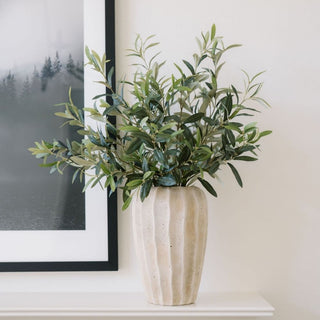
For a vanity with more depth, or a counter with a vessel sink that creates negative space on one side, the 29" Artificial Olive Tree introduces a looser, more sculptural form. The soft grey-green of the olive leaf works particularly well against warm wood tones, which is consistent with the material palette of most contemporary bathroom vanities.
Small Bathroom and Powder Room Design: One Piece, One Position

In a small bathroom, the design logic is simple even if the execution requires more discipline: one well-chosen piece in one deliberate position is the entire intervention. The temptation to layer is strong, particularly when a space feels unfinished. But in a room where surfaces are already limited, adding multiple pieces without a clear compositional reason creates density without purpose.
The most effective positions in a small bathroom are the corner of the vanity counter, a floating shelf positioned at or above eye level, or a narrow ledge near or behind the toilet where vertical form reads without taking up functional space. In each of these positions, the piece needs to have enough presence to register without being the dominant object in the room.
The 27" Potted Snake Plant works consistently across all three positions. Its vertical form is naturally suited to tight spaces, and the structured silhouette holds its own without additional styling. The 29" Artificial Olive Tree works well on a wider counter or a shelf with enough depth to support it, and the looser branching structure makes it feel less rigid in a small space than a more architectural species would.
For powder rooms specifically, the counter is often the only viable surface. A powder room with a pedestal sink or a compact floating vanity calls for something that makes a statement without occupying the full surface area. This is where the Orchid earns its place: the height of the stem and the brightness of the bloom create enough visual presence to anchor the room without adding physical mass. The Japandi principle applies directly here: one considered element communicates more than a collection of smaller gestures. For more on how this translates across the home, our post on Japandi design covers the full aesthetic framework.
Material Pairings: Reading the Room Before Choosing the Plant
Greenery does not exist in isolation. Its effect is always relative to the surfaces around it. A silvery-green olive leaf reads differently against white subway tile than it does against dark herringbone or warm wood paneling. Understanding this before choosing a species saves the adjustment work that comes from bringing a piece home and realizing the tones are fighting rather than complementing.
As a general framework: lighter, more delicate leaf forms like the olive or the orchid work well against darker or more dramatic tile, where the contrast is the point. Architectural, upright forms like the snake plant or the agave work well in rooms with strong horizontal lines, where the vertical element provides the counterpoint the room needs. Looser, multi-stem structures like the Dracaena read best in rooms with enough visual space around them to appreciate the form.
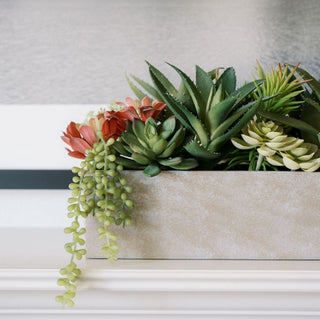
Interior designers consistently note that the introduction of texture is one of the most direct routes to a bathroom that feels considered rather than standard. Greenery contributes a specific kind of texture that no other decorating element replicates: irregular, organic, and structurally complex. The 31.5" Artificial Agave and the 2' Artificial Fiddle Leaf Fig both bring that textural quality at a scale that works in a primary bathroom with enough counter or floor clearance. The Fiddle Leaf's broad, sculptural leaves introduce warmth and roundness into what is often a vertically biased room.
Larger Bathrooms, Vacation Rentals, and Commercial Spaces

A primary bathroom with a freestanding tub, a hotel suite, an Airbnb, or a commercial wellness space operates on different design logic than a compact home bathroom. The room is large enough to support floor-level greenery, and in many cases a floor piece is necessary to keep the space from feeling sparse or under-considered.
This is where the 4' Artificial Dracaena Tree and the 40" Artificial Snake Plant in Black Pot do their best work. The Dracaena's multi-stem structure and its sculptural height create a genuine focal point between a vanity and a freestanding tub, which is precisely the kind of transitional space that larger bathrooms struggle to fill. The white ceramic pot it photographs in reinforces the spa register. The 40" Snake Plant in its matte black pot takes a different approach: it is graphic, architectural, and highly legible against light-colored walls or pale tile. In a rental or commercial space, both pieces offer the additional advantage of requiring zero maintenance while holding their visual presence indefinitely, which is a practical consideration that genuinely matters at that scale.
The design principle for these larger spaces is the same as it is for compact ones: place the piece where the eye travels naturally, not where the space simply has room for it. In a bathroom with a freestanding tub, that is almost always the corner nearest the tub or the window wall. In a commercial suite, it is the transition point between the vanity area and the bath or shower zone. Greenery marks that transition structurally. It gives the eye a place to rest between one part of the room and another.
For more on how these principles extend across the home's most-trafficked spaces, our 2026 interior design trends post covers where the broader design conversation is heading.
Designer Answers: Your Bathroom Greenery Questions
What is the best faux plant for a small bathroom?
The best faux plant for a small bathroom is one that provides vertical presence without occupying significant horizontal space. The 27" Potted Snake Plant from the Hunter Collection is a strong choice because its upright silhouette fits a counter corner, a narrow shelf, or a ledge without spreading into the functional area of the room.
Can you put faux plants in a bathroom?
Yes, and in many cases faux plants are the more practical choice for a bathroom. Low-light conditions, humidity fluctuation, and maintenance limitations make live plants difficult to sustain in most bathrooms. A well-crafted faux piece delivers the same structural and visual benefit without any of those constraints.
How do you decorate a bathroom counter with plants?
Treat the vanity as a single composition rather than a surface to be balanced. Choose one clear position for the greenery, typically at a counter corner or beside the mirror, and let it anchor that position without competing with functional objects. A piece at roughly counter height or slightly above, with a form that contrasts the hard surfaces around it, will read as intentional rather than decorative.
What are good powder room design ideas for small spaces?
In a powder room, restraint is the design strategy. One well-chosen piece carries more visual weight than several smaller gestures. A compact orchid or a structured snake plant on the vanity surface, positioned near the mirror where it benefits from reflection, gives a small space a considered, finished quality without adding physical mass.
What is biophilic design in a bathroom?
Biophilic design in a bathroom is the intentional use of organic forms, natural materials, and plant life to soften a hard-surfaced environment and create a sense of calm. It does not require a large intervention. A single sculptural plant positioned where the eye naturally rests can shift the entire register of the room from clinical to restorative.
How do you make a bathroom look more luxurious with plants?
The association between plants and luxury in a bathroom comes from the spa and hospitality sector, where a single well-placed orchid or a sculptural floor plant signals that the space was designed with intention. The key is material coherence: choose a plant whose form and vessel complement the existing finishes rather than introducing a competing visual element.
How do you decorate a small bathroom at home on a budget?
One piece, placed well, is more effective and more economical than several pieces placed without a clear intention. A compact potted plant on the vanity corner or a small plant on a shelf above the toilet changes the register of the room for a fraction of what a renovation would cost. The investment is in choosing the right piece for the specific position rather than accumulating greenery and hoping it reads as designed.
The Powder Room and Beyond with CG Hunter

The bathroom is not a secondary room when it comes to design. It is one of the few spaces in the home occupied in complete solitude, which makes the quality of its atmosphere more legible, not less. A well-placed piece of greenery in a bathroom does not decorate the room. It completes it. Explore the full Hunter Collection for pieces designed to hold their presence in the rooms that demand the most from them. For weekly design perspective, find us on Substack. Follow along on @cghunterhome on Instagram, Pinterest, and TikTok.