![]() The In-Between Season: Why January Feels Difficult (And How Designers Think About It)
The In-Between Season: Why January Feels Difficult (And How Designers Think About It)
There's a specific kind of disorientation that arrives in early January, when the holiday decorations come down and the house suddenly feels like it's waiting for something. The rooms look larger but less defined. The light seems harsher. Nothing is technically wrong, yet the space doesn't feel quite like home.
This isn't a psychological phenomenon that happens to coincide with interior design. It's a direct result of how our homes are structured, and how abruptly that structure changes when we transition out of the holiday season. Understanding why this moment feels so destabilizing requires thinking like a designer: recognizing that our environments shape our emotional experience in measurable, predictable ways.
Why Removing Holiday Decor Creates Spatial Disorientation

When you dismantle a Christmas tree, you're not just removing an object. You're eliminating a vertical anchor that has been organizing the visual field of an entire room. That tree has been directing sight lines, balancing furniture arrangements, and providing a focal point that everything else in the space has been oriented around, even subconsciously.
Holiday decorations, regardless of style or scale, function as a comprehensive design layer. Garlands create horizontal movement. Wreaths add symmetry to doorways and windows. Candles and string lights establish ambient glow that softens architectural edges. When this entire system is removed within a day or two, the home doesn't return to its pre-holiday state. It reveals a kind of structural absence.
This is particularly acute in spaces that were marginal to begin with. A living room that felt adequately furnished in November may suddenly seem underdressed in January, because the seasonal layer was compensating for gaps in the foundational design. The mantel that looked finished with a garland now reads as a bare horizontal plane. The console table that supported a ceramic village now just holds a lamp and some mail.
Designers recognize this as a predictable transition, not a personal failing or a deficiency in taste. The solution isn't to rush into redecorating or to leave the house stripped down until spring. It's to understand that January requires a different kind of spatial strategy, one that accounts for less natural light, more time spent indoors, and the absence of a culturally agreed-upon aesthetic framework.
The Architecture of Low-Light Living
January is defined, architecturally, by light deficit. Depending on latitude, the sun may not rise until after 7 a.m. and sets before 5 p.m. This compressed daylight window doesn't just affect mood. It fundamentally changes how interiors are perceived. Even February feels dark and glooming as it longs for spring.
Rooms that felt warm and inviting in October can appear flat or institutional in January, because the same paint color behaves differently under winter light. North-facing rooms, which may have been tolerable with holiday lighting, become genuinely uncomfortable. Spaces near windows (previously desirable) now expose how much cold air infiltrates even well-insulated homes.
Professional designers approach this period by treating the home as a low-light environment that needs deliberate compensation. This doesn't mean adding more overhead lighting, which often exacerbates the clinical feeling. It means building in light sources at multiple levels: table lamps that create pools of warmth, floor lamps that bounce light off ceilings, candles in substantial holders that provide flicker and movement without reading as decorative excess.
The principle here is layered illumination, the same strategy used in hospitality design to make hotel lobbies feel welcoming regardless of weather. A single overhead fixture leaves a room feeling exposed. Three smaller light sources, placed thoughtfully, create dimension and allow the space to feel inhabited even when it's technically empty.
This is also the time to evaluate window treatments honestly. Sheer curtains that provided privacy in summer may now be allowing too much cold air perception, even if they're not causing actual heat loss. Heavier fabrics, or layered treatments that combine sheers with lined panels, don't just insulate. They add vertical softness that counteracts the starkness of bare walls.
Visual Anchors in Winter

The reason a home feels unmoored after the holidays isn't sentimental. It's compositional. Holiday decorations, whatever their aesthetic, provide visual anchors: points of focus that organize how we perceive and move through a room. A wreath centers a doorway. A garland defines the mantel as a focal plane. A centerpiece claims the dining table as an intentional surface rather than a catchall.
When these elements are removed, the home doesn't return to neutral. It exposes whatever structural gaps existed before. This is why designers don't advocate for minimalism in January. The appropriate response isn't to strip the home down further; it's to replace temporary anchors with permanent ones that can carry the space through the season.
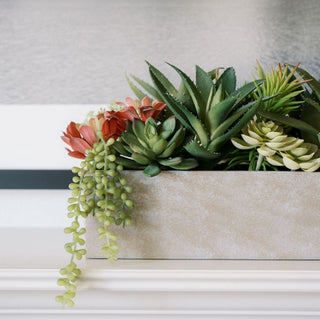
Greenery serves this function with particular effectiveness. Not the abundant, ornamental greenery of the holidays, but quieter, architectural forms: branches in tall vessels, potted plants with sculptural leaves, eucalyptus stems arranged with intention rather than abundance. These elements provide the vertical and horizontal lines that organize a room without requiring the commitment of furniture rearrangement.
Faux options are particularly suited to this purpose. They maintain visual consistency in environments where natural light is insufficient for living plants, and they allow for scale and placement that real greenery often can't accommodate. A six-foot branch arrangement can anchor a corner in a way that's structurally similar to a Christmas tree, but without any seasonal association. For a deeper exploration of how high-quality faux greenery can support this transition mindset, CG Hunter's perspective on starting fresh with faux plants offers practical context.
Vessels and sculptural objects function similarly. A large ceramic vase, even when empty, creates a focal point. A wooden bowl, a stone sculpture, a collection of candleholders in varying heights: these aren't decorations in the seasonal sense. They're spatial tools that provide visual weight and help define zones within a room.
The goal is to establish quiet structure: elements substantial enough to organize the space, restrained enough not to compete with the architecture itself.
Why January Should Not Look Minimal
There's a common impulse in early January to embrace minimalism as a corrective to holiday abundance. This makes intuitive sense. If the problem is that the house feels cluttered and overstimulated, surely the solution is to strip everything down to essentials.
But this conflates two different concepts: visual restraint and spatial emptiness. True minimalism is a highly curated aesthetic that requires excellent architecture, abundant natural light, and a significant investment in high-quality foundational pieces. What most people achieve when they "go minimal" in January is simply an under-furnished house that feels cold.
Designers distinguish between calm and barren. A calm interior has everything it needs and nothing it doesn't, but "everything it needs" includes texture, warmth, and visual interest at multiple scales. This might mean layered textiles: a sofa with substantial pillows, a throw blanket with visible weave, a rug that defines the seating area and provides literal and visual warmth.
It includes surfaces that show intentional arrangement rather than emptiness. A coffee table shouldn't be bare. It should hold a small stack of books, a tray with a candle, perhaps a low bowl with natural objects. These elements signal that the space is tended and inhabited, which is psychologically essential during a season when the external environment offers very little sensory reward.
The principle here is supported restraint. Each element should be deliberate, but the cumulative effect should be one of sufficiency, not austerity. January interiors need to feel generous in texture and warmth even as they avoid visual noise.
For room-specific applications of this layering principle, particularly in the spaces where we spend the most time during short days, CG Hunter's guide to creating cozy living rooms translates these concepts into actionable arrangements.
The Emotional Architecture of Transition Spaces

January's difficulty is compounded by the fact that it's a transition month with no clear visual identity. December has an established aesthetic vocabulary. March begins to reference spring. January exists in between, and our homes must function without the support of seasonal symbolism.
This is where designers think about the home as an emotional environment, not just a physical one. The goal isn't to decorate for January specifically. It's to create conditions where the transition itself feels manageable. This means prioritizing comfort over novelty, sufficiency over excitement.
Textiles become particularly important during this period. Heavyweight curtains, wool or bouclé throws, layered rugs: these aren't seasonal decorations, but they are seasonal necessities. They provide tactile warmth that compensates for reduced daylight and help define spaces that might otherwise feel too open or undefined.
Scent also plays a structural role, though it's rarely discussed in these terms. The absence of pine, cinnamon, and other holiday fragrances leaves a gap that many people don't consciously register but definitely feel. Replacing this with something warm but not seasonal (amber, sandalwood, woodsmoke) helps the home feel inhabited and intentional rather than waiting for the next thing.
This is adjacent to but distinct from the emotional wellness strategies that focus on combating winter malaise through light therapy, routine, and social connection. For that broader environmental context and how the home supports psychological well-being during darker months, CG Hunter's piece on combating winter blues addresses the intersection of space and mood more directly.
What Designers Keep, Remove, and Introduce
The post-holiday transition isn't about removing everything celebratory and waiting for spring. It's about editing thoughtfully and understanding which elements serve the space structurally versus which were purely seasonal.
Designers typically remove anything explicitly referential: ornaments, Santa figures, holiday-specific textiles, anything red and green in combination. But they often retain elements that are seasonally appropriate without being holiday-specific: evergreen branches (real or faux), white or cream candles, metallic accents, certain types of berry stems or pine cones if they read as winter rather than Christmas.
Exterior elements deserve particular attention. A wreath doesn't have to come down on December 26th if it's composed of materials that reference winter rather than Christmas specifically. Magnolia, eucalyptus, and mixed evergreens can carry a doorway through February without feeling leftover. For specific approaches to this exterior transition, CG Hunter's guide to wreaths after Christmas offers examples that maintain presence without seasonal confusion.
What gets introduced depends on what the space needs structurally. If the removal of a tree has left a corner feeling empty, that's where a substantial plant or a floor lamp might go. If the dining table feels bare without a centerpiece, a low arrangement of branches or a collection of candleholders provides focus without requiring maintenance.
The logic here is replacement, not addition. January doesn't need new categories of objects. It needs the right objects in the places where holiday decorations were doing structural work.
The January Aesthetic: Supported Neutrality

If January has a design identity, it's supported neutrality: spaces that feel complete and intentional without relying on color, pattern, or obvious decoration. This is harder to achieve than it sounds, because it requires that the foundational elements of a room be genuinely sufficient.
In practical terms, this means ensuring that each room has:
- Adequate, layered lighting that doesn't depend on overhead fixtures alone
- Textiles that provide warmth and softness at multiple scales
- At least one focal point or visual anchor that organizes the space
- Surfaces that show intentional arrangement rather than emptiness or clutter
- A color palette that reads as warm or neutral rather than cold or institutional
These aren't January-specific requirements. They're the underlying structure that a well-designed home needs year-round. But they become acutely visible in January, when there's nothing seasonal to distract from gaps or deficiencies.
For a comprehensive framework on how to think about this seasonal moment more broadly, including practical approaches to individual rooms and spaces, CG Hunter's overview of decorating in January provides additional context that complements this structural perspective.
Designer Answers: How Professionals Approach the Post-Holiday Home
How do designers decorate after Christmas?
Designers treat the post-Christmas period as an editing process rather than a redecorating project. They remove explicitly holiday-specific items while retaining elements that provide structure: evergreen branches, candles, and textiles that support the room's function. The focus is on replacing lost visual anchors with permanent elements like substantial plants, sculptural vessels, and layered lighting. The goal is a complete space that doesn't depend on seasonal decoration.
What decor should stay out after Christmas?
Elements that serve the space structurally rather than symbolically can remain: neutral candles in quality holders, evergreen arrangements that read as winter rather than holiday-specific, throws and pillows in natural textures, mirrors that reflect limited daylight, and any metallic or glass objects that add dimension without seasonal association. The test is whether an item supports the room's function and aesthetic year-round, not whether it was introduced during the holidays.
What replaces Christmas decor in winter?
Winter requires visual anchors that organize space without seasonal specificity: branches or greenery in tall vessels for vertical interest, layered textiles for warmth and softness, sculptural objects or ceramics that create focal points, candlelight at multiple levels for warmth, and artwork or mirrors that add dimension to walls. These elements provide the structure that holiday decorations were offering temporarily, but with permanence appropriate to the longer season.
How should a home feel after the holidays?
A well-structured post-holiday home feels complete and intentional, not empty or waiting. It should offer warmth through layered textiles and lighting, visual interest through purposeful objects and arrangements, and a sense of sufficiency rather than excess or austerity. The space should feel inhabited and tended, with each room showing deliberate composition that doesn't depend on seasonal symbolism. Comfort and functionality take precedence over novelty or decoration.
The Longer View

January's difficulty is structural, not personal. The disorientation that many people feel when holiday decorations come down is a predictable response to a genuine shift in how the home is organized and how it functions as a visual environment.
Understanding this (that the problem is architectural rather than emotional) makes it solvable. Homes don't need to be redecorated for January. They need to be properly structured so that they can function without the support of seasonal decoration. This means building in sufficient light, warmth, texture, and visual anchoring so that the space feels complete regardless of what else might be layered on top during celebratory seasons.
The goal is a home that works in transition, not just at aesthetic peaks. January, seen this way, isn't an awkward gap between more interesting seasons. It's a test of whether the foundational design is actually doing its job.
Moving Through the Season Intentionally
The transition out of the holidays doesn't have to feel like loss or waiting. When approached with the same intentionality that designers bring to any seasonal shift, January becomes an opportunity to see your home clearly, to understand what it needs structurally rather than decoratively.
This kind of spatial thinking extends beyond the immediate post-holiday moment. It informs how you approach every transition: how you layer comfort into rooms where you spend the most time, how you think about bringing life into spaces without depending on fresh flowers, how you create visual interest on exterior surfaces that need to work across multiple seasons.
The principles remain consistent: support rather than excess, intention rather than emptiness, warmth that comes from structure rather than sentiment. January simply makes these principles more visible, and more necessary.
For more on creating intentional spaces during the winter months:
-
Fresh Start with Faux Plants – How high-quality faux greenery supports the mindset of renewal without the pressure of "starting over"
-
Decorating in January – A comprehensive seasonal framework for approaching the post-holiday home
-
Cozy Living Rooms – Room-specific strategies for layering warmth and comfort where it matters most
-
Combat the Winter Blues – How your environment affects mood and what design can do to support emotional well-being
-
After Christmas Wreaths – Exterior solutions that maintain presence through the winter without feeling seasonal
Discover more timeless winter design solutions and thoughtfully curated pieces for the transitional season throughout the CG Hunter collection. Follow @CGHunterHome on Instagram, Pinterest, TikTok, and Substack for daily inspiration on creating spaces that honor the past while embracing the present. For wholesale, please shop wholesale on FAIRE at cghunter.faire.com.