The Difference Between Minimal and Cold Has Finally Been Named
Minimalism has spent the last decade being blamed for rooms that feel more like waiting rooms than homes. The empty corner, the all-white palette, the single chair facing nothing in particular. That was never minimalism's fault. It was a misreading of it, and 2026 is the year the design world finally corrected course. Warm minimalism is described as the single biggest trend designers are all adopting next year, and the name itself does the explaining: keep the restraint, lose the cold.
A minimal room and a stark room are not the same thing, even though they have been treated as interchangeable for years. The difference is material, not quantity.
Why Stark Minimalism Stopped Working

Warm minimalism works as a comforting bridge between cool restraint and exuberant maximalism, calm but characterful, simple but never sterile. That single line explains the entire shift. A room can hold very few objects and still feel inhospitable if every one of those objects is hard, glossy, or temperature-neutral. The fix was never "add more." It was "choose warmer."
This is consistent with how multiple design publications are independently describing the same moment. Coverage of the warm minimal interiors trend points to the same conclusion from a different angle: restraint that still reads as inviting depends almost entirely on texture and material temperature, not on how much is in the room.
How Warm Minimalism Differs From the Trends Around It
One of the most common questions people ask about this trend is how it differs from Japandi, and the confusion is fair, since both share a vocabulary of restraint, natural materials, and quiet color palettes. The distinction is in the source of that warmth. Japandi blends Japanese minimalism with Scandinavian hygge specifically, which means its warmth comes from a defined cultural pairing, wabi-sabi imperfection meeting Nordic coziness, with rules about wood tone, joinery, and proportion baked into the aesthetic. Warm minimalism has no such cultural framework. It is a looser correction to minimalism generally, pulling in whatever natural materials and warm finishes counteract sterility, without Japandi's more specific design lineage.
It is also worth separating from the two aesthetics currently positioned at the opposite end of the spectrum. Cluttercore embraces intentional abundance, more objects, more layering, more visible personality, which is nearly the inverse instinct of warm minimalism's restraint. Grandmillennial decor shares warm minimalism's rejection of sterility, but gets there through pattern, vintage objects, and inherited pieces rather than through paring back. All three trends are responding to the same complaint, that modern homes had gotten too cold or too impersonal, but warm minimalism is the only one of the three that solves it while keeping a minimalist's restraint intact.
Texture Is Doing the Work Color Used to Do

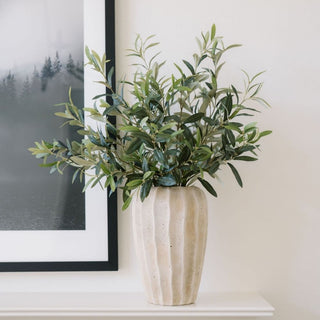
For years, "warm" in a minimal room meant a beige wall. That's no longer the mechanism. The 10.6" Natural Terracotta Vase demonstrates this clearly. Its soft, hand-thrown cream finish carries warmth through texture and surface variation, not through color choice, since every piece is hand-thrown by artisans and no two finishes are identical. Set on a console with nothing else competing for attention, a single piece like this carries more warmth than an entire wall of paint ever could.
This is the actual argument behind warm minimalism: a room can stay sparse and still feel handmade, provided the few objects in it carry real material presence.
Height and Form Replace Visual Clutter
A room with very little in it still needs a focal point, or it reads as unfinished rather than restrained. This is where scale matters more than quantity. The 7' Artificial Palm Tree gives a sparse room a single commanding presence, height and movement in place of additional furniture or decor. One tall, well-formed piece does the job that five smaller accents would otherwise be recruited to do, and it does it without adding visual noise.
Set into the French Rattan Basket rather than its plain grower pot, the same tree gains the natural, woven texture that grounds it in the room instead of floating in a corner. The basket itself is a small lesson in the whole trend: a plain black pot is functional, a handwoven rattan one is warm, and nothing else about the tree had to change.
Warm Light Sources Change a Room After Dark

Daylight is forgiving. A room that feels balanced at noon can feel sterile again the moment the sun goes down, unless something in it is built to carry warmth after dark. The 3.5" Iron Candleholders in Antique Brass solve exactly this gap. Hand-forged iron with an antique brass finish reads as warm even unlit, and lit, it becomes the room's actual source of warmth once daylight fades.
A set of three gives a mantel or table the layered height that a single object can't, without requiring any additional surface clutter to achieve it.
Designer Answers
Q: What is warm minimalism and how is it different from regular minimalism?
A: Warm minimalism keeps the restraint of traditional minimalism but replaces cold, glossy, or sterile materials with natural textures, organic forms, and warm-toned finishes, so a sparse room still feels inviting rather than empty.
Q: Is warm minimalism the same as Japandi?
A: No. Japandi is a specific cultural pairing of Japanese minimalism and Scandinavian hygge with its own material rules, while warm minimalism is a broader correction to minimalism generally, drawing on any natural material or warm finish that counteracts a sterile room.
Q: Where can I buy warm minimalism home decor online?
A: CG Hunter sells natural-material vases, faux trees, woven baskets, and warm-toned candleholders suited to the warm minimalism aesthetic, available directly at cghunter.com with free shipping on orders over $150.
Q: How do I make a minimalist room feel warmer without adding clutter?
A: Choose fewer, more textural pieces, a handcrafted vase, a woven basket, an iron candleholder in a warm finish, rather than adding more objects, since material warmth does the work that quantity used to be asked to do.
Q: What materials define the warm minimalism trend in 2026?
A: Natural terracotta, rattan, iron with warm metal finishes, and faux greenery with real height and texture all define the look, prioritizing material warmth over a strictly neutral or cold palette.
The Room That Finally Makes Sense

Warm minimalism isn't a correction of minimalism's ambition, it's a correction of how that ambition got executed. Keep the room sparse. Just stop choosing materials that have no temperature at all. A terracotta vase, a tall faux tree in a woven basket, a few pieces of warm-toned iron, that's the whole list, and it's enough.
For more on building a home around fewer, better pieces, visit the Designer Journal weekly, read our companion piece on Substack, and follow along on Instagram, Pinterest, and TikTok for more styling ideas from CG Hunter.