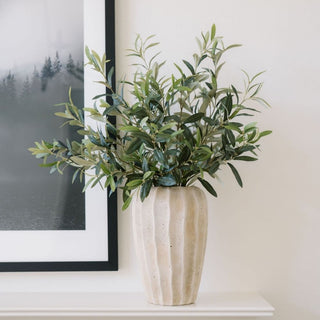
The olive tree has become one of the most requested pieces in residential and commercial interiors. It earns that position for structural reasons: the branching silhouette reads as architecture, the silver-green foliage holds its tone across warm and cool palettes, and the trunk carries enough visual weight to anchor a corner without competing with furniture. The challenge is not finding an artificial olive tree that looks right. The challenge is placing it correctly. Done well, a faux olive tree resolves a room. Done carelessly, it reads as an afterthought. This guide walks through each room of the home and the spatial logic that determines where an olive tree belongs, what scale to use, and which CG Hunter styles perform best in each setting.
Why Faux Olive Trees Work in Almost Every Room

The olive tree functions more like a structural column than a decorative object. It defines a vertical plane, draws the eye upward, and creates a sense of inhabited space without adding surface clutter. This is why it translates so readily across rooms that seem to have nothing in common.
What tends to hold up in real homes is a tree that does not call attention to itself. The best placement decisions are the ones that make a room feel more complete rather than making the tree feel prominent. Scale, position, and proportion are the variables. The tree itself is the constant.
Living Room Placement: Scale, Corner Logic, and the Floor-to-Ceiling Ratio
The living room is where most olive trees end up, and where most placement mistakes happen. The instinct is to push the tree into a corner. That is not always wrong, but a corner placement demands a tree with enough width and fullness to occupy the space without looking lost against the wall behind it. The 7.5' Olive Tree and the 8' Artificial Olive Tree are built for this. Their height approaches ceiling height in most standard rooms, which creates the floor-to-ceiling rhythm that makes a space feel considered.
Flanking a sofa or fireplace is a more deliberate move. Two trees at equal height on either side of a fireplace surround create symmetry that reads as intentional. For asymmetrical arrangements, a single tree at the far end of a seating group creates a visual full stop, signaling where the conversation area ends and the rest of the room begins.
A tree in a living room should read as furniture-scale, not accent-scale. If the tree disappears behind the sofa, it is too small. The 6.5' Artificial Shady Lady Olive Tree is the minimum workable height in a standard 9-foot ceiling room. The 7' Wispy Olive Tree works well in rooms where the olive tree needs to feel lighter and more open, particularly where the furniture is already substantial.
Entryway and Foyer Placement: The First Impression Problem

The entryway has one job: to set the tone for everything that follows. A faux olive tree in a foyer says the home takes its interiors seriously, without announcing it directly. This is the structural reasoning behind why olive trees appear in so many foyers in design publications.
For narrow entries, the 7' Artificial Slim Olive Tree is purpose-built. Its compressed footprint allows it to occupy a foyer corner or flank a console without intruding into the circulation path. Wider foyers benefit from a taller, more open tree. The 8' Artificial Olive Tree clears most console heights comfortably and creates a layered backdrop that reads well both on entry and when photographed. Position the tree so it is visible from the front door but does not block the sightline into the room beyond. The tree should frame the entry, not obstruct it.
Bedroom Placement: Restraint and the Case for One Quiet Piece
Bedrooms are often over-planted. Multiple pots of greenery across windowsills, dressers, and nightstands create a density that works against the calm a bedroom is meant to provide. One well-placed olive tree does more. It introduces organic form, height, and texture without adding visual noise to a room that needs to feel settled.
The most effective placements are beside a reading chair, in a corner facing the bed, or flanking the dresser. Each position adds verticality to a space that tends toward horizontal planes: mattress, duvet, nightstand, dresser. The olive tree interrupts that rhythm without competing with the bed as the room's focal point. The 6.5' Artificial Shady Lady Olive Tree and the 7' Wispy Olive Tree both have the lightness of branch structure that makes them sit quietly in a bedroom without dominating it. The faux olive tree in a bedroom is not about drama. It is about calibrated presence.
Bathroom Placement: Where the Olive Tree Earns a Surprising Return

Primary bathrooms are an underused opportunity. They have the volume and the neutral backdrop that make an olive tree feel architectural rather than decorative. Stone tile, warm plaster walls, and wood vanity tones all complement the silver-green of olive foliage without competing with it.
A freestanding bathtub creates the ideal anchor point for a full-size tree. Positioning one beside or at the foot of the tub creates the kind of considered quality that appears in high-end hotel interiors. Because the tree is faux, there are no concerns about moisture or fluctuating humidity. It holds its form and color regardless of the room's conditions.
Not every bathroom has the floor space for a full tree, and that is where the 29" Artificial Olive Tree earns its place. It sits directly on a wide vanity counter, brings the same organic silhouette and honest branch structure of a full olive tree into a compact footprint, and does not require floor space to do it. Beside a black faucet, against marble tile, reflected in a bathroom mirror, it reads as a complete design moment rather than a filler plant. For bathrooms with more room to work with, the 4' Fruitless Olive Tree in Pot is the next step up in scale. Sign up to be notified when it becomes available.
Dining Room Placement: Structure Without Surface Clutter
The dining room presents a specific problem. The table and chairs already dominate the space. Adding greenery at tabletop or sideboard level creates competition rather than composition. An olive tree solves this by operating in the vertical plane the furniture leaves empty, above the furniture line entirely.
Corner placement works well here, particularly in corners that would otherwise feel unresolved. The 8' Artificial Olive Tree clears the table height and delivers canopy at ceiling level, giving the dining room a sense of volume that smaller pieces cannot achieve. For rooms with a sideboard, a tree placed at one end creates a natural asymmetry that turns the sideboard into a composition rather than a surface display.
Home Office Placement: Presence Without Distraction

A tree positioned behind the desk and visible in video calls creates a natural backdrop that communicates thoughtfulness. It reads as a real interior rather than a staged one, which matters in a period when how a home office reads on camera has become part of professional presentation. The tree should sit behind the desk chair, visible over the shoulder, not placed to the side where it reads as an afterthought. That positioning creates depth in the frame, which is what makes a video background feel like a room rather than a wall.
The 7.5' Olive Tree and the 9.8' Faux Arbequina Olive Tree in Pot are both strong choices depending on ceiling height and room scale. The Arbequina is worth considering for offices with 10-foot ceilings or rooms that have enough square footage to support a more statement-level piece.
Commercial and Trade Placement: Lobbies, Reception Areas, and Hospitality Spaces
The olive tree is one of the most frequently specified faux trees in commercial interiors. Its scale works across lobby volumes, its neutral color complements branded palettes, and unlike flowering or tropical species, it reads as sophisticated across a wide range of design directions.
For reception areas, two trees flanking a desk create bilateral symmetry that reinforces authority and calm. The olive tree works here because it is architectural enough to hold the scale of a commercial lobby without looking theatrical. For hotel lobbies and restaurant entries, the 9.8' Faux Arbequina Olive Tree in Pot is often the right scale. Its denser foliage and heavier trunk read as a specimen tree rather than a decorative accessory, which is exactly what a commercial space requires.
How to Shape and Position an Olive Tree After Unboxing
 Placement is only half the equation. Most faux trees arrive compressed from packaging, and the branches require shaping before the tree reads as natural. Skipping this step is the most common reason a well-chosen tree fails to deliver. Our full guide on assembling and shaping your olive tree covers this in detail.
The goal is asymmetry. Real olive trees do not grow symmetrically. Rotate the trunk slightly off-center, allow some branches to extend farther than others, and resist the urge to fill every opening. The spaces between branches are part of what makes an olive tree read as real. For guidance on selecting the right variety before you commit, see our post on which olive trees are best indoors.
Designer Answers: Frequently Asked Questions About Faux Olive Tree Placement
What size faux olive tree is best for a living room? In a room with 9-foot ceilings, a 7' to 8' tree is the right range. Below 7', the tree reads as undersized against standard furniture. Above 8', the crown risks touching the ceiling, which flattens the silhouette and eliminates the sense of height the tree is there to create.
Can a faux olive tree go in a bathroom? Yes, and bathrooms are one of the strongest placements. The 29" Artificial Olive Tree sits on a wide vanity counter and delivers the full visual quality of an olive tree without requiring any floor space. For bathrooms with more room, a floor tree beside the tub creates the kind of considered quality that appears in high-end hotel interiors. Because faux trees require no water or light, there are no maintenance concerns in a bathroom setting.
What is the difference between the Arbequina and a standard olive tree? The Arbequina has denser, more compact foliage and a heavier trunk. The 9.8' Faux Arbequina Olive Tree in Pot reads as a full-grown specimen tree and is the right choice for spaces that need genuine visual mass. Standard olive trees have a more open, wispy branch structure that works better in residential rooms where the goal is lightness rather than presence.
Should a faux olive tree go in a pot or a basket? The vessel matters as much as the tree. A pot that is too small makes the tree look rootless regardless of how good the tree itself is. As a general rule, the planter should be proportional to the trunk base, not scaled to the tree height. A basket of the right diameter adds warmth and texture that reads as intentional.
How do I make a faux olive tree look real? Open the branches wide enough to reveal the trunk. Avoid perfectly even branch distribution. Position some branches forward and some backward to create depth. Conceal a plastic base inside a basket with moss at the soil line. The single most important step is asymmetry. A tree that looks identical from every angle reads as artificial. One that changes as you move around it reads as real. For a complete technique guide, see our post on which olive trees are best indoors.
What rooms are faux olive trees not ideal for? Rooms with ceilings under 8 feet can make a tall olive tree feel cramped. The crown has nowhere to breathe, and the proportions read as forced. In those spaces, a shorter tree, a tabletop arrangement, or a stem grouping in a tall vessel is more proportional to the room.
The placement decision is a design decision. A faux olive tree in the right room, at the right scale, in the right position, resolves space. It does not fill it. The difference between the two is intentionality, and that is something no tree achieves on its own.
Style with CG Hunter

Explore the full range of faux olive trees in our collection. For more on technique, proportion, and how to integrate faux greenery into a considered interior, the Designer Journal is updated weekly. Find us on Substack and follow along on Instagram, Pinterest, and TikTok at @cghunterhome.