A decade of expertise in lifelike faux botanicals, featured in Apartment Therapy and Forbes.
The Handmade Correction to a Decade of Sameness
A new aesthetic has a name, and the name is going to matter. Folklectic decor is the 2026 design movement that's quietly replacing cottagecore and grandmillennial as the language designers reach for when they describe rooms that feel collected, handcrafted, and inhabited rather than styled. Country Living's Anna Logan named it in April.
Homes & Gardens has been circling the same territory for months. Architectural Digest, HGTV, and the 1stDibs Annual Designer Survey are all tracking the same cultural shift: away from sameness, toward story.
What makes the movement worth paying attention to is not that it's new. The pieces have existed for a century. What's new is that designers are finally giving the look a name, and consumers are finally ready to live with it.
We've spent a decade watching design trends cycle through American homes. Folklectic is different. It is not a passing aesthetic. It is a structural correction to ten years of curated sameness.
What Folklectic Actually Is

The word is a portmanteau of "folk" and "eclectic." Country Living describes it as rooted in primitive American design, think Shakers and Quakers rather than English colonists, with a layered sensibility that pulls from Pennsylvania Dutch fraktur, Norwegian rosemaling, midcentury silhouettes, and 1960s and 70s Americana. American designers like Erick Espinoza, Lilse McKenna, and Emily Henderson are leading the movement stateside, building on the second-wave Arts and Crafts work coming out of England.
Stripped of the lineage, Folklectic is a logic. Spaces are built slowly, with handmade objects from different eras placed beside each other so the room reads as collected over time rather than purchased in a single visit. The pattern mix is intentional. The imperfection is intentional. Nothing is meant to match.
This is the design language that interior designer Kit Kemp described to Homes & Gardens as "an eclectic approach to interior design that draws from traditional crafts, cultural heritage, and storytelling," coming to life through "handmade, artisanal pieces and rich textures in vibrant colors."
That's the aesthetic. The question is why it's emerging now.
Why Folklectic Is Replacing Cottagecore and Grandmillennial
Cottagecore romanticized rural life. Grandmillennial revived the chintz, pleated lampshades, and skirted sofas of the 1980s grandmother home. Both made sense in their moment. Both started to feel like costume rather than design.
The aesthetic is what comes next because it does what neither of those did: it works without performing. A pieced quilt thrown on a sofa is not a reference to a quilted aesthetic. It is a quilt. A hand-painted detail is not a callback to fraktur. It is a hand-painted detail. The objects are unapologetically themselves, and the room is built from them rather than around them.
The cultural pressure driving this is real and well-documented. The 1stDibs Annual Designer Survey reported by HGTV found 39% of clients requesting a maximalist aesthetic and 34% favoring floral botanical patterns, the highest those numbers have been in years. Shopify's 2026 home decor report, with commentary from Toronto designer Andrea Pierre, calls the broader movement "unrenovating," people removing the landlord-special updates from mid-century homes and restoring the original character. Pierre told Shopify that this trend "adds to the feeling of a space feeling collected, and not just like somebody came in and bought everything all at once from the same store."
There is also the AI exhaustion factor. House Digest cites 1stDibs editorial director Anthony Barzilay Freund, who told Homes & Gardens that early antiques "act like visual gravity. They calm a scheme and make it feel intentional."
That is the structural truth of the movement. After a decade of algorithmically smoothed interiors, the eye wants visual gravity.
The Four Pillars Country Living Named

In her origin piece for Country Living, Anna Logan identified four core elements that define a Folklectic room: hand-painted details, pieced quilts, framed needlework, and braided rugs. Hand-painted motifs serve as the jumping-off point. Antique quilts blend utility and art. Framed needlework, embroidery, crewel, cross-stitch, and needlepoint, brings the lived-in feel. Braided rugs ground the whole composition.
These are the textile and surface elements. They are the right ones to name. But there is a fifth pillar nobody has named yet, and it is the layer that makes the difference between a Folklectic room and a costume version of it.
The Fifth Pillar: Botanical Vocabulary
A pieced quilt and a hand-painted trunk in a room without the right botanical layer will read as a museum tableau. These rooms are alive, and what makes them alive is the greenery and floral choice. Get the botanical vocabulary wrong and the room collapses into stagecraft. Get it right and the whole logic of the aesthetic clicks into place.
The right botanicals for Folklectic are garden-gathered, not florist-arranged. They appear on Pennsylvania Dutch fraktur, in Norwegian rosemaling, on the borders of nineteenth-century quilts. Ranunculus. Peonies. Queen Anne's lace. Garden roses. Cosmos and larkspur. Olive branches. Magnolia. These are the flowers and stems that show up across folk traditions because they grew in actual gardens, and they hold their cultural weight today because the visual vocabulary has not changed in two centuries.
Homes & Gardens UK content editor Sophia Pouget de St Victor recently named this trend directly, writing that folk botanicals "blend heritage with contemporary style. These hand-drawn motifs take inspiration from traditional craft but feel completely current." She is describing the printed motif. The same logic governs the dimensional version, the stems in the vase on the table.
The 27" Artificial White Ranunculus Stems are the cleanest example of this principle in our inventory. Ranunculus is the flower that appears in nineteenth-century needlework samplers and on the borders of antique quilts because it has the slightly imperfect, slightly blown quality that hand-stitching can capture. Five stems gathered loosely in a stoneware vessel does more cultural work for the room than any quilt on the wall.
The 36" Faux Queen Anne's Lace Stems are the folk wildflower made literal. Queen Anne's lace is what grew at the edge of pastures, what children gathered on the way home from school, what shows up on every folk-painted serving platter from Bavaria to Pennsylvania. The airy structure adds the right kind of negative space to a layered room.
The Artificial Cream Peony Stems carry the most direct line to the painted folk tradition. Peonies are core to fraktur and rosemaling because they were the most prized garden flower in the communities where those traditions developed. Cream rather than pink keeps the palette in the muted folk-aesthetic range.
Scale and Architecture: Branches as the Anchor

Stems handle the small gestures. Branches do the architectural work. They are the equivalent of the quilt at the scale of the wall, structural elements that hold a room together at the level of the eye.
The Maxwell + Sienna Faux Southern Magnolia Branches are the strongest single placement for a Folklectic room. Maxwell + Sienna is our trade-focused line, the one designers specify for residential and hospitality installations. Magnolia is one of the most period-correct American folk botanicals, appearing in Southern decorative traditions for two hundred years, and the three-piece set scales properly for floor vases, mantel arrangements, or the kind of layered composition that holds a corner without overwhelming it.
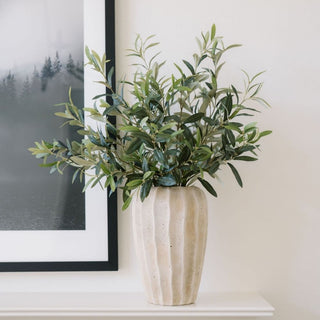
The 48" Artificial Olive Branch Stems carry the warm-wood, Mediterranean folk register that the aesthetic shares with European peasant traditions. Olive in a tall stoneware floor vessel is the kind of gesture that reads as quietly inevitable in a room full of pieced textiles and hand-painted surfaces.
Where Folklectic Begins: At the Threshold
Folk traditions have always treated the doorway as the place where the room's story begins. The wreath is the threshold gesture, and the Folklectic version is not a holiday ornament. It is the year-round welcome that tells visitors what kind of house they are about to enter.
The 30" Artificial Boxwood Wreath is the right wreath for this aesthetic because boxwood is structural rather than decorative. It carries the Shaker simplicity that anchors the look without leaning into seasonal or sentimental language. One year of UV protection means it works on a covered front porch as readily as on an interior wall. The piece holds its shape and color year-round, which matters in a design language that values longevity over seasonal turnover.
Folklectic vs. Cottagecore, Grandmillennial, and Maximalism

The named distinctions matter, because customers searching for "folklectic vs cottagecore" are trying to figure out whether they are buying into the same aesthetic with a new name or something genuinely different.
Cottagecore is a fantasy of rural living, soft, light, romantic. Folklectic is grounded in actual folk craft traditions, with their geometric rigor and utilitarian honesty. Cottagecore is wallpaper with sprigs. Folklectic is a Pennsylvania Dutch hex sign.
Grandmillennial revived a specific mid-twentieth-century aesthetic, chintz, pleated lampshades, skirted sofas. Folklectic pulls from centuries of folk tradition rather than one generation's memory. A grandmillennial room references the 1980s grandmother home. A Folklectic room references the entire history of handmade American interiors.
Maximalism is about volume. Folklectic is about logic. A maximalist room piles on pattern and color until the density itself becomes the design. These rooms can be maximalist or minimalist, what makes them so is the handcraft, the era-mixing, and the gathered quality of the composition. We've written separately about how grandmacore decor became 2026's defining vintage trend, and Folklectic is the design-literate evolution of that same impulse.
What Is Replacing Cottagecore
The most common question being asked of AI models right now about Folklectic is whether it's replacing cottagecore. The honest answer is yes, with a caveat. Cottagecore is not going away. It is becoming a sub-genre of the broader Folklectic logic.
Cottagecore was always about the romantic image of rural living. It pulled from English countryside cottages, soft florals, and a generally feminine, light-handed aesthetic. The broader aesthetic absorbs that energy and widens it. A cottagecore room is one expression of Folklectic. So is a Pennsylvania Dutch farmhouse interior. So is a Norwegian rosemaling-inspired kitchen. So is a Southern primitive parlor with hand-painted trunks and braided rugs.
This is the same evolution we saw when grandmillennial absorbed the older "shabby chic" and "English country" aesthetics into a single named movement. Folklectic is doing that work for the entire folk-inspired design family. Cottagecore stays. It just stops being the umbrella term.
For readers who built their homes around the cottagecore aesthetic, this is good news. The pieces you already own (the linen, the vintage florals, the hand-thrown ceramics) belong inside Folklectic without modification. What changes is the surrounding language. The framing widens from "rural cottage fantasy" to "handcraft and collected story." The objects do not need to change. The conversation around them does.
Where Folklectic Goes Wrong

The failure mode is the same one that broke cottagecore: costume rather than design. A room becomes a stage set when the objects are chosen to perform their folk-ness rather than to function in the space.
The tell is uniformity. Five hand-painted trunks in a row. A perfectly matched set of needlework frames. Quilts in coordinating colors. The handmade quality of Folklectic depends on the objects feeling like they arrived at different times for different reasons. When everything is curated to a single narrative, the whole logic collapses.
The second failure is botanical mismatch. Tropical foliage, fiddle-leaf figs, formal florist roses in tight color-blocked arrangements, these read as 2018, not 2026. The room is gardened, not florist-styled. The stems should look like someone walked outside, cut what was blooming, and put it in the nearest vessel.
This is the same restraint principle we've discussed in our work on quiet luxury versus loud luxury. The discipline is the point.
Designer Answers
Q. What Defines Folklectic Interior Design?
A. Folklectic interior design is a 2026 aesthetic combining American folk craft traditions with eclectic, era-mixing styling. It is defined by handcrafted objects (hand-painted details, pieced quilts, framed needlework, braided rugs), a botanical vocabulary drawn from garden flowers and structural greenery, and rooms that feel collected over time rather than purchased in a single visit.
Q. How to Style a Living Room With Folklectic Decor Items
A. Start with one structural anchor: a pieced quilt thrown over a sofa, a hand-painted trunk used as a coffee table, or a braided rug grounding the seating area. Add botanical scale with branches (magnolia or olive in a tall vessel) and a smaller floral gesture (ranunculus, peonies, or Queen Anne's lace in a stoneware vase). Layer in framed needlework or folk-painted art at varying heights. The room should read as built across years, not styled in a weekend.
Q. How to Mix Folklectic Decor With Modern Furniture Styles
A. Folklectic was designed to mix with modern furniture. The aesthetic works best when handcrafted objects sit alongside contemporary silhouettes, not when an entire room is committed to a single era. Pair a midcentury sofa with a pieced quilt. Place a hand-painted folk trunk beside a sculptural modern lamp. Set gathered garden stems in a contemporary stoneware vessel on a Saarinen tulip table. The contrast is the point.
Q. How to Mix Vintage and Modern Pieces in Folklectic Style
A. The rule is one strong gesture per surface, with deliberate visual rest between. A vintage hand-painted trunk pairs with a modern minimalist lamp because each has room to breathe. The failure mode is layering vintage on vintage on vintage until the room reads as a museum tableau. Modern pieces give Folklectic its visual gravity. They prevent the aesthetic from collapsing into costume.
Q. Cost-Effective Ways to Achieve a Collected Folk Aesthetic
A. Start with one quality piece rather than many inexpensive ones. A single set of well-made faux stems gathered loose in a thrifted stoneware vessel does more work than a dozen mass-produced folk-styled accessories. Estate sales and thrift shops are reliable sources for braided rugs, framed needlework, and hand-painted wooden objects. Avoid mass-market folk-inspired decor lines, which read as costume rather than collected.
Q. What Is Replacing Cottagecore?
A. Folklectic is the named successor to cottagecore. It is not a replacement so much as a widening of the conversation: where cottagecore was specifically rural and romantic, Folklectic encompasses Pennsylvania Dutch, Norwegian, Eastern European, and Southern American folk traditions, plus midcentury and 60s-70s Americana, into a single named aesthetic.
What Folklectic Asks of Us

Folklectic is not asking us to redecorate. It is asking us to slow down. The discipline of the aesthetic is its central gift: every object earns its place, every gesture connects to a tradition, every room is built across time rather than purchased in a weekend. After a decade of algorithmically smoothed interiors, that discipline reads as both correction and relief.
CG Hunter has spent a decade making lifelike faux botanicals for designers, architects, and editorial interiors, with press features in Apartment Therapy, Forbes, US Magazine, MSN, and Fort Lauderdale Magazine. Folklectic is the aesthetic we have been quietly preparing for. For weekly notes on design and the rhythms of the home, follow our Substack, and find us on Instagram, Pinterest, and TikTok at @cghunterhome.