How to Choose the Right Scale for the Space You Have
Most rooms fail with greenery for the same reason: the tree is the wrong size. Too small, and it disappears into the furniture. Too tall, and it crowds the ceiling line and reads as decoration crammed into a space that cannot hold it. The right faux tree, scaled correctly, behaves like architecture. It anchors a corner, frames a sightline, or finishes a room that otherwise feels unresolved. Choosing the right size starts with the ceiling, the surrounding furniture, and the function the tree needs to perform.
This faux tree size guide walks through the four working categories of indoor trees by height, from tabletop pieces under three feet to architectural specimens approaching ten. Each section names the rooms and styling moments that suit that scale, and where each size resolves a design problem rather than creating one.
Why Scale Matters More Than Species

Scale is the relationship between the size of an object and the size of the space around it. Proportion is the relationship between objects within that space. Both principles govern whether a tree reads as intentional or as filler. Homes & Gardens, in its overview of the core principles of interior design, frames focal points as a function of the room's architecture rather than a styling afterthought. A tree should align with that architecture, not fight it.
The working rule most designers return to is to leave roughly twelve inches of clearance between the top of the tree and the ceiling. For an eight-foot ceiling, that places the tree in the seven to seven-and-a-half foot range. For a nine-foot ceiling, eight feet. For ten-foot or vaulted ceilings, nine feet and up. The rule sounds restrictive, but it produces the same effect every time, which is a tree that looks rooted in the space rather than wedged into it.
MasterClass, in its breakdown of scale and proportion, reinforces the same principle from the architectural side: design elements should be sized to the ceiling height first and to surrounding furniture second. A tree that scales correctly to the ceiling will almost always sit correctly with the furniture around it. The reverse is rarely true.
Under 3 Feet: Tabletop and Accent Scale
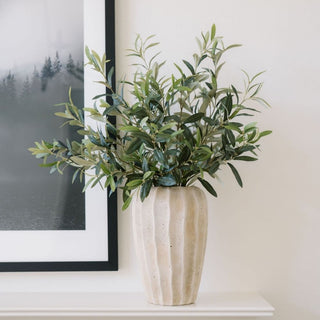
Trees under three feet operate differently from floor pieces. They are not focal points. They are completing elements, used to finish a console, soften a kitchen counter, or add height to a mantel arrangement without overwhelming what is already there. The Artificial Olive Topiary Tree with Mediterranean Pot is the working example. At thirty-four inches in a textured pot, it sits comfortably on a console or sideboard, brings the same silvery foliage as a full-size olive tree, and reads as a refined accent rather than a centerpiece.
The design discipline at this scale is restraint. A tabletop tree should never compete with the surface it sits on. If the console is already styled with a lamp and a piece of art, the tree completes the vignette. If the console is bare, the tree becomes too important. The right placement is one of three elements at most.
3 to 5 Feet: Filling Floor Gaps Without Dominating

This is the range that solves the most common design problem in a home, which is the awkward floor gap. A space beside a sofa, the foot of a bed, the floor next to a bathroom vanity, the corner of a home office. None of these spaces can hold a full-height tree, but they all look unfinished without something vertical. Trees in the three to five foot range fill the gap, add a layer of greenery, and stay in scale with the furniture they sit beside.
The 40" Artificial Snake Plant in Black Pot brings strong vertical lines into a tight footprint, which makes it well suited to narrow corners and entryways. The 3' Faux Potted Philodendron reads as softer and more organic, with broader leaves that work better in living rooms and bedrooms where the room calls for warmth rather than structure. The 5' Artificial Monstera Tree sits at the upper end of the range and brings tropical sculpture into spaces that need a real visual moment without committing to a floor-to-ceiling specimen.
Trees in this range are also the most flexible to move. A five-foot tree that gets in the way in the living room can finish a guest bedroom. The category rewards homes that style seasonally without resetting.
6 to 8 Feet: Statement Scale for Standard Ceilings
This is the working range for most living rooms, primary bedrooms, dining rooms, and entryways with standard eight to nine foot ceilings. A tree in this range is a focal point. It anchors a corner, fills the space behind a sofa, or flanks a fireplace as a structural pair. At this scale, the tree carries the same visual weight as a substantial piece of furniture, which is exactly the role it should play.
The 7.5' Faux Potted Olive Tree is the most versatile piece in the range. The silvery foliage works in nearly any palette, the silhouette is loose enough to feel organic, and the height resolves a nine-foot ceiling without crowding it. The 8' Faux Olive Tree is the next step up for slightly taller rooms or for placements where the tree needs to read as a true structural piece, such as a corner beside a low sofa or a wall with high ceilings stepping into a vault.
The 7' Citrus Lemon Tree brings a different design argument. Its small fruit and bright green foliage suit kitchens, breakfast rooms, and Mediterranean-leaning interiors where a soft pop of color earns its place. It functions less as a quiet architectural piece and more as a styled focal point, which is the right call in rooms that want a little more visual energy.
For more on shaping and styling a tree at this scale, our guide to shaping, cleaning, and styling a faux tree covers the technique. And for olive trees specifically, the olive tree styling guide walks through placement room by room.
Over 9 Feet: Architectural Scale for Vaulted and Open Spaces

Rooms with ten-foot ceilings and above need trees that match the vertical space, or the room will read as unresolved. These are the spaces where standard-height trees disappear and where the proportions of the room itself become the design problem. Trees over nine feet are architectural pieces. They are designed to behave like installed elements rather than styled accessories.
The Maxwell + Sienna line is built specifically for this scale and these settings. The 9.8' Faux Arbequina Olive Tree in Pot brings the layered green and silvery foliage of a mature olive tree at a height that resolves a great room or two-story entryway. The 9' Faux Fiddle Leaf Fig Tree in Pot delivers the sculptural broad-leaf silhouette that has defined contemporary interiors for the last decade, scaled correctly for the rooms that actually have the ceiling height to hold it. The 9.8' Faux Shady Lady Tree in Pot reads as a true architectural feature, with tiered branching and an elongated trunk built for hospitality settings and large residential spaces where the tree itself becomes part of the room's structure.
Trees at this scale change the rules of styling. The pot matters more, the soil-line treatment matters more, and the placement is permanent in a way smaller trees never are. These are pieces selected once and lived with for years.
Pots, Bases, and the Other Half of Scale
A correctly sized tree in the wrong vessel still reads as wrong. The pot should be proportional to the trunk base, which usually means narrower than the canopy and wide enough to ground the tree without dwarfing it. A tree placed in an oversized planter looks unbalanced. A tree placed in a planter too small for its trunk looks unrooted. The vessel is part of the proportion calculation, not a separate styling decision made afterward.
For bathrooms and humid rooms, the bathroom faux plant placement guide covers vessel and placement details specific to that environment.
Designer Answers: How to Choose the Right Size Tree

Q: How tall should my faux tree be for an eight-foot ceiling?
A: Aim for a tree in the six-and-a-half to seven-and-a-half foot range. The rule is to leave about twelve inches of clearance between the top of the tree and the ceiling. A tree taller than seven and a half feet in an eight-foot room will crowd the canopy against the ceiling line and read as wedged in rather than rooted.
Q: What size faux tree do I need for a room with vaulted or two-story ceilings?
A: Rooms over ten feet need trees at least nine feet tall to read as proportional. Anything shorter disappears into the vertical space. For two-story entryways and great rooms, the Maxwell + Sienna trees in the nine-foot-plus range are built for that scale.
Q: Can a small tree work in a large room?
A: Only when grouped or layered. A single small tree in a large room reads as undersized and gets lost. Two or three smaller trees of varying heights, or a single small tree paired with a tall floor tree, can create the layered greenery that resolves a large space. A single small tree alone almost never works.
Q: What is the right size faux tree for a corner beside a sofa?
A: The tree should be tall enough to extend above the back of the sofa by at least a foot, and ideally taller. For a standard thirty-three inch sofa back, a tree in the five to seven foot range is the right scale. Anything shorter sits below the sofa line and reads as decoration rather than a structural element.
Q: How do I shop for trees by size on the CG Hunter site?
A: The trees collection page includes a "Shop by Size" filter in the sidebar with three height ranges: Under 3', 3' to 5', and Over 6'. The filter narrows the full collection to the size that fits your room, which is the fastest way to see what is available at the scale you need.
The Right Scale Resolves Everything Else
A tree in the right scale does not need much else. The room reads as composed, the corner reads as finished, and the rest of the styling falls into place around the new vertical line. Most styling problems are sizing problems first. Once the scale is correct, the species, the pot, and the placement become refinements rather than corrections.
The trees featured here are a starting point, not the full range. Browse the complete collection on the trees page and use the Shop by Size filter to narrow by the height your room needs. For more on technique, proportion, and the design discipline behind a considered home, the Designer Journal is updated weekly on Substack, and you can follow @cghunterhome on Instagram, Pinterest, and TikTok.