A decade of expertise in lifelike faux botanicals, featured in Apartment Therapy and Forbes.
The Base Is Not an Afterthought
Most people choose a faux tree the way they choose a painting. They focus on the canopy, the height, the fullness, the species, and they treat whatever the tree is standing in as packaging. This is the single most common reason a faux tree looks faux. The canopy is rarely the problem. The base almost always is.
The pot or planter a tree sits in does more than hold it upright. It sets the proportion, finishes the silhouette, and signals whether the tree was placed with intention or simply parked. Understanding what your tree arrives in, and what to do with it, is what separates a tree that reads as decor from one that reads as an afterthought.
How to Know What Pot Your Tree Includes

At CG Hunter, faux trees arrive one of two ways, and the product title and images tell you which.
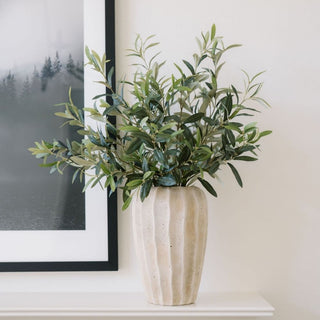
If the title references a pot directly, the tree comes in a decorative container designed to look finished the moment it is unboxed. The 4' Fruitless Olive Tree in Pot is the example here. It arrives in a stone-toned decorative pot, ready to place with no extra styling required.
If the title does not reference a decorative pot, the tree arrives in a standard nursery or grower pot. The 7' Artificial Magnolia Tree, the 7' Citrus Lemon Tree, and the 7' Artificial Eucalyptus Tree all arrive this way. The nursery pot is a simple black base, roughly 8.25 inches wide by 9.5 inches tall, built for structure and stability rather than display. It is an invitation to choose the planter yourself, and the starting point for a more custom, designer-styled look. Reviewing the product images with dimensions before purchasing will always confirm which base is included.
What a Nursery Pot Actually Gives You
A nursery pot, also called a grower pot, is the inner foundation of the tree. It holds the trunk steady and keeps the tree upright, and each CG Hunter tree includes a hard faux dirt base set into that pot for added weight and a natural appearance. That base is fixed and not designed to be removed.
The advantage of a nursery pot is freedom. A tree that arrives undressed can be styled to its exact room. A woven basket creates a relaxed, organic look. A metal or ceramic container reads more architectural and refined. The same magnolia can feel like a farmhouse entryway tree in one vessel and a modern living room sculpture in another. The planter is where the tree becomes yours.
How to Style a Tree Inside a Decorative Planter

For the most finished result, place the existing nursery pot directly inside a larger decorative planter or basket. Choose a planter proportional to the tree, with enough interior width for the grower pot to sit comfortably. Interior designers often work from the principle, described by MasterClass in its scale and proportion guidance taught by designer Kelly Wearstler, of building a room around its most important piece. A 7-foot tree is that piece, and its planter has to carry the visual weight.
The Jaipur Curve Metal Container, with its hammered brass-tone finish and softly waved rim, gives a tree like the 7' Artificial Magnolia a polished, architectural base that holds its own in a living room or entryway. For a warmer, more textural look, the French Rattan Basket brings handwoven, natural-fiber softness that suits the airy structure of the 7' Eucalyptus. Curated Sets pair trees and baskets like these together when a coordinated look is the goal.
If the planter is deeper than the nursery pot, add sturdy filler to the bottom first. Packing paper, cardboard, or foam will raise the tree to the correct height so the canopy sits where the eye expects it. A riser at the base of a decorative pot is also a designer trick for adding discreet height, useful when you want a little more drama from a tree but a taller size is not right for the room. Once the tree is positioned, finish the top with moss, stones, or filler to conceal the base and complete the transition.
You Can Layer a Decorative Pot, Too
A tree that arrives in a decorative pot already looks finished, but it can still be layered for more depth. Because the 4' Fruitless Olive Tree is compact, its decorative pot can be set inside a larger basket or planter, with moss tucked over the top to bridge the two vessels. Layering a decorative pot inside a larger one is a designer styling choice that adds texture and dimension, not something the tree requires.
The Finishing Layer: Moss
 Designer Chase Hill (@ChaseHillHome) pressing moss around the trunk of a faux tree to conceal the nursery planter for a finished, designer look.
Moss is the detail that turns a styled tree into a believable one. A handful of natural or preserved moss pressed over the base hides the pot rim and softens the line where the tree meets its vessel. We use and recommend SuperMoss, and our full moss styling guide with designer Chase Hill walks through the technique in detail. As StoneGable notes in its guide to decorating with scale and proportion, it is the relationship between elements, not the cost of them, that makes a room feel pulled together. Moss is a small, inexpensive gesture that does exactly that.
Choosing a Planter That Fits the Room
Proportion is the quiet rule behind every well-placed tree. A planter that is too small makes a tree look top-heavy and unstable. One that is too large swallows the trunk and throws off the balance. Minotti London, in its guidance on scale and proportion, describes how the wrong proportions break the visual flow of a room, and a faux tree is no exception.
As a working guide, the planter should be visually substantial enough to anchor the tree without competing with its canopy. In an entryway or a corner, a taller vessel like the Jaipur Curve adds height and formality. In a living room or sunroom, a wider woven basket like the French Rattan reads relaxed and grounded. Match the planter to the room's character, and confirm the interior is wide enough for the nursery pot before you buy. Our full guidance on shaping and finishing a tree is covered in our faux tree styling guide, and our faux olive tree styling guide goes deeper on placement room by room.
Designer Answers

Q. How Do You Choose the Right Size Planter for a Faux Tree?
A. Choose a planter with enough interior width for the nursery pot to sit comfortably inside, and enough visual mass to anchor the tree without overwhelming the trunk. For a 7-foot tree, a substantial floor planter is appropriate. Always check the product images with dimensions to confirm the nursery pot size, roughly 8.25 inches wide for CG Hunter trees, before purchasing a planter.
Q. How Do You Choose a Planter Based on Tree Type?
A. Match the planter to the tree's character. An architectural tree like magnolia suits a structured metal or ceramic container. An airy tree like eucalyptus or olive pairs well with a woven basket for a softer, organic feel. The planter should echo the mood you want the tree to set in the room.
Q. How Do You Make a Faux Tree Look Authentic in Its Container?
A. Conceal the base. Place the nursery pot inside a decorative planter, raise it with filler if needed so the canopy sits at the right height, and finish the top with natural or preserved moss to hide the pot rim. The moss layer is what makes the transition from pot to tree read as believable. For a step-by-step demonstration, watch the video by designer Chase Hill featured in our moss styling guide.
Q. Can You Put a Potted Tree Inside Another Planter?
A. Yes. A tree that arrives in a decorative pot can be layered inside a larger basket or planter for added depth and texture, especially smaller trees like a 4-foot olive. Tuck moss over the top to bridge the two vessels.
Q. Do CG Hunter Decorative Planters Come With the Tree?
A. Only when the product title references a pot. Decorative planters shown in styled photography are sold separately unless the listing states otherwise. Trees without a pot reference in the title arrive in a standard black nursery pot.
More Styling Tips from the Designer Journal
A faux tree is only as convincing as the base it stands on. Choose the planter with the same care you gave the tree, scale it to the room, conceal the nursery pot, and finish the top with moss. The canopy will always draw the eye first. The base is what makes the eye believe it. For more styling guidance like this, explore the Designer Journal, follow our Substack for weekly notes on design, and find us on Instagram, Pinterest, and TikTok at @cghunterhome.