When a Designer Says "I'm Already Proposing It for Client Work," That Is the Real Review
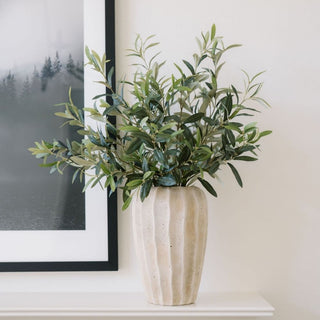
The most useful signal in the faux olive tree market is not a star rating. It is the moment a working interior designer takes a product out of its packaging, looks at it, and decides on the spot to specify it for a paying client. That is what happened recently with Nashville-based designer Warner Tyne of Nashville Design Collective, who received the 9.8' Faux Arbequina Olive Tree in Pot from Maxwell + Sienna and responded, "The tree looks amazing. Already proposing them for client projects. Everyone that sees it falls in love." She opened a trade account the same week.
Maxwell + Sienna is the trade-focused line from CG Hunter, designed specifically for interior designers, architects, hospitality buyers, and event professionals who need ultra-refined faux botanicals for client projects. The line operates as a cousin brand to CG Hunter, inheriting the same craftsmanship legacy while speaking the architectural language of design professionals.
What Makes a Faux Olive Tree Look Real

Most faux olive trees fail the same way. The trunk reads as plastic, the leaves are a uniform green that does not exist in nature, and the canopy is too symmetrical to read as a living thing. A faux olive tree that looks real solves all three problems at once. The trunk has color variation and texture that mimics the gnarled bark of a Mediterranean olive. The leaves carry the silvery underside that gives real olive foliage its shimmer in changing light. The branches grow in the slightly asymmetric, slightly weeping pattern that distinguishes a mature olive from a topiary. From a design perspective, those three details are the difference between a piece that disappears into a room and a piece that gets noticed for the wrong reasons.
Why the 9.8' Arbequina Reads as Architecture, Not Decoration
The 9.8' Faux Arbequina Olive Tree in Pot is a structural piece. At nearly ten feet, it occupies vertical space the way a column or a tall window does, anchoring a room rather than accenting it. In rooms with ten-foot or taller ceilings, common in new builds and the high-end residential work designers like Warner Tyne specify for, this is the scale that makes a corner feel composed instead of empty. Arbequina is a Spanish olive variety known for its slender, silvery-green leaves and a graceful, slightly weeping silhouette. That refined leaf structure is what allows the tree to read as authentically Mediterranean rather than generic, which is the difference between a faux olive tree a designer will specify and one she will pass over.
The Specification Standard Is Higher Than the Retail Standard
A piece specified for a client project has to survive close inspection from the homeowner, the contractor, the photographer, and the designer's own portfolio. It has to hold its proportion at room scale, read as believable from three feet away, and look intentional next to live finishes like stone, plaster, and wood. That is a much narrower window than most retail buyers demand, and it is the window Maxwell + Sienna products are engineered for. The benefit reaches homeowners too. A faux olive tree built to designer-grade standards will outlast and outperform a budget version that has to be replaced every two years.
How Maxwell + Sienna Compares to Other Faux Plant Brands

Maxwell + Sienna sits in a specific gap in the market. Competitors may seem approachable but stems-focused, but budget-focused, often prioritizing price over realism. Winward is luxury-priced and aimed at top-tier hospitality. Maxwell + Sienna brings the craftsmanship standard designers expect at that top tier into a pricing structure that works for residential trade projects and design-conscious homeowners. The voice of the line is closer to Restoration Hardware than to a big-box artificial-plant supplier. The reference points are architectural, the palettes are restrained, and the materials are selected for permanence rather than seasonal turnover.
Other Maxwell + Sienna Pieces That Specify Well
Designers tend to build out a project in layers, and trees alone do not finish a room. The Artificial 2-Stem Phalaenopsis Pink Orchid works as a tabletop counterweight in a bedroom, a powder room, or a guest suite, where the scale of live orchids would require constant replacement. The 12" Artificial Boxwood Plant in Round Pot is a workhorse: it sits well on a kitchen counter, a console, or in a bathroom, and at twelve inches it carries enough presence to register without dominating. For the vessels themselves, the 12.75" Arendal Flora Vase in Black and the 9.5" Arendal Venus Vase in Black function as the sculptural element when paired with a stem or shown alone, and their darker mango-wood palette pairs cleanly with the moody, layered interiors trending across high-end residential work right now.
If the Arbequina Is Not the Right Variety, the Shady Lady Is

Olive varieties are not interchangeable, and the right one for a project depends on the foliage character a designer is after. Arbequina reads finer, with narrower leaves and a more open canopy. For projects that call for a fuller, denser tree with a more pronounced silvery sheen, the 9.8' Faux Shady Lady Olive Tree in Pot is the better specification. Same height, same architectural impact, different botanical signature. Designers working with the Maxwell + Sienna trade team can request both for comparison before committing to a specific project.
What the Trade Program Offers Designers and Specifiers
The Maxwell + Sienna trade program is built for the way designers and specifiers actually work. Trade pricing is set so a piece can be specified for client projects without erasing the designer's margin. Account holders get direct access for product questions, sourcing, and project-specific recommendations. The product range covers what a designer typically needs for a full project at once, from anchor trees to tabletop florals to vessels, so a single source can finish a room rather than requiring assembly from four different suppliers. For architects and hospitality buyers working on larger installations, the line extends into the scale and quantity that commercial work demands.
Designer Answers

Q: What makes a faux olive tree look real?
A: Three details: a trunk with color variation and texture that mimics gnarled olive bark, leaves with a silvery underside that catches changing light, and an asymmetric, slightly weeping branch structure rather than a perfect symmetrical canopy. When all three are present, the tree reads as believable from social distance. Warner Tyne's response after handling the 9.8' Arbequina Olive Tree, "Everyone that sees it falls in love," is the pattern those three details produce.
Q: What is the difference between the Arbequina and Shady Lady olive trees?
A: Both are olive varieties, but their foliage character differs. Arbequina has narrower, more open leaves with a graceful, slightly weeping silhouette, ideal for projects that want a refined, Mediterranean read. Shady Lady carries denser, fuller foliage with a more pronounced silvery-green tone, better suited to projects that need more visual weight at height.
Q: What is the Maxwell + Sienna trade program?
A: Maxwell + Sienna is the trade-focused line from CG Hunter, designed specifically for interior designers, architects, hospitality buyers, and event professionals. Trade accounts receive professional pricing and dedicated account support. Applications are available through the CG Hunter website.
Q: Are Maxwell + Sienna products suitable for hospitality and commercial projects?
A: Yes. The line is used in boutique hotels, restaurants, retail spaces, and design studios. The materials and construction are engineered for the longevity that commercial installations require, including settings where live plants are impractical because of light, scale, or maintenance budgets.
Q: What size faux olive tree should I choose for my room?
A: For rooms with ten-foot or taller ceilings, a 9.8' tree like the Arbequina or the Shady Lady reads as a structural anchor. For nine-foot ceilings, an 8' tree generally proportions correctly. The principle is to choose a tree tall enough that it relates to the architecture, not to the furniture beside it.
A Designer's Endorsement Is the Closing Argument
When a working designer specifies a faux olive tree for a client, no amount of marketing copy carries the same weight. Maxwell + Sienna was built to earn that response. The product has to do the work first. The trade infrastructure exists to make that work easier to repeat, and the same craftsmanship that earns a designer's specification is what makes the piece worth owning at home. For more on how to specify and style faux botanicals, read more on the Designer Journal, follow @cghunterhome on Instagram, Pinterest, and TikTok, and subscribe to our Substack for weekly editorial.