The Art of Making an Artificial Olive Tree Read as Part of the Room, Not an Object Placed in It
A faux olive tree can resolve a room or sit in it like a prop. The difference is rarely the tree. It is almost always the styling. The same 7' olive tree that anchors a designer's living room can look adrift in a homeowner's, and the gap between the two outcomes comes down to a small set of decisions: how the tree is shaped, what it sits in, what surrounds its base, and how it relates to the architecture around it. This guide walks through the styling decisions that make a faux olive tree look like a considered piece of the interior rather than a recent purchase. It is built for homeowners and designers who want the editorial quality of a magazine interior without the maintenance of a real specimen tree.
Why the Olive Tree Has Become the Defining Indoor Tree of the Decade

The olive tree has earned its place in interiors for structural reasons, not trend ones. Its silver-green foliage holds across warm and cool palettes, the trunk carries enough weight to anchor a corner without crowding furniture, and the open branching reads as architecture rather than decoration. Apartment Therapy noted this directly when it covered the demand surge driven by big-box availability, calling out the explosion of interest in tall faux olive trees as homeowners look for a low-maintenance way to bring Mediterranean structure indoors.
What distinguishes a CG Hunter olive tree from a budget version is not the silhouette in a photograph. It is the leaf detail, the trunk weight, and the branch flexibility that allow the tree to be styled rather than merely placed. The styling possibilities scale with the quality of the piece.
Start with Shaping: The Step Most Homeowners Skip
Almost every faux olive tree arrives compressed from packaging. The branches are bent inward, the canopy is flat, and the silhouette looks more like a bottle brush than an olive tree. Skipping the shaping step is the most common reason a well-chosen tree fails to deliver. A detailed walkthrough lives in our guide on how to shape, clean, and style a faux tree, but the principle is worth stating here.
The goal is asymmetry. Real olive trees do not grow as a uniform sphere. They lean toward light, drop branches at uneven heights, and leave gaps between clusters where you can see through to the trunk. Bend each branch outward and slightly downward, then rotate clusters so some sit forward and some recede. Pull a few branches lower than the rest. Resist the urge to fill every opening. The space between branches is what makes the tree read as real.
Choose the Vessel Before You Place the Tree

The vessel determines whether the tree reads as styled or unfinished. A pot that is too small makes the tree look rootless regardless of how good the foliage is. As a working rule, the planter diameter should relate to the trunk base, not the tree height. A heavier trunk needs a heavier vessel. A wispy trunk reads better in a more restrained pot.
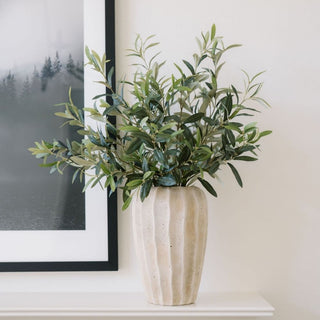
For the 7' Olive Tree, the included vessel is sized to the proportions of the tree and ready to drop into place. For trees that ship as the tree alone, the choice opens up. Aged terracotta reads as Mediterranean and slightly weathered. A tall woven basket warms the base and reads as more lived-in. Concrete or stone planters lean architectural and contemporary. Glazed ceramic in muted clay or charcoal reads as more refined. The decision should reflect the rest of the room, not the tree.
Hide the Mechanics at the Soil Line
The fastest way a faux tree gives itself away is at the base. A visible plastic insert, an exposed fabric anchor, or bright green foam at the soil line breaks the illusion no matter how well the canopy is shaped. The fix is simple. Cover the surface with a layer of dried sheet moss, river stones, or cut pieces of natural burlap. Sheet moss is the most forgiving and reads as the most realistic. Press it down around the trunk so the base of the tree appears to grow out of the planter rather than sit inside it. For a deeper look at how moss shifts the entire feel of a styled piece, our guide on styling with moss walks through the technique in detail.
If the tree is in a basket, line the inside with a piece of dark fabric before adding the moss layer. The dark backdrop prevents any glimpse of plastic from catching the eye when light hits the basket from the side.
Match the Tree to the Architecture, Not the Other Way Around

A common mistake is choosing an olive tree based on what looks good in product photography rather than what fits the room's proportions. The tree should respond to the architecture around it.
In rooms with 9' ceilings, the 8' Olive Tree reaches the right vertical scale to read as a structural piece rather than a decorative one. In a corner beside a sofa, behind a reading chair, or flanking a fireplace, an 8' tree creates the floor-to-ceiling rhythm that makes a space feel composed.
For rooms with 10' ceilings or taller, the 7' Olive Tree often still works, but the styling needs to compensate for the extra ceiling height. A taller planter, a layered base, or a tree placed on a low platform can recover the proportion.
For tighter footprints, particularly entryways, narrow corners, or rooms where the tree needs to sit beside furniture without dominating, the 6.5' Artificial Shady Lady Tree carries the same olive-tree presence in a slightly more compressed silhouette. It is the right minimum height for most residential placements.
The 4' Fruitless Olive Tree in Pot operates differently. It is not a floor tree in the structural sense. It works on a wide entry console, a primary bathroom vanity with depth, or a kitchen counter near a window. Treat it as an architectural accent rather than an anchor piece.
Style the Floor Around the Base
A faux olive tree placed directly on hardwood or tile reads as floating. Adding floor-level styling around the base completes the composition and integrates the tree into the room.
A small woven rug under the planter adds material and grounds the tree visually. A pair of stacked design books beside the planter, a low ceramic vessel, or a leaning piece of art behind the tree all create the layered quality that designers build into editorial interiors. The rule is restraint. One or two grounding elements, not five. Over-styling at the base undoes the structural calm the tree is there to create.
Light the Tree Like It Belongs

Lighting is the styling element most homeowners forget. A faux olive tree positioned in a dim corner reads as dead space. The same tree placed where it catches afternoon light, or where a nearby floor lamp throws a soft glow across the canopy, comes alive. The branches cast shadows. The leaves appear to move. The tree behaves like a living one would.
If the placement is fixed and the natural light is limited, a slim floor lamp positioned just behind or beside the tree solves the problem. The light should illuminate the canopy and reveal the trunk, not flatten the silhouette with direct front lighting.
Pair Two Trees for Symmetry, One for Asymmetry
For symmetry, two trees of equal size flanking a fireplace, a sofa, a doorway, or a bed frame create a bilateral composition that reads as designed rather than decorated. Curated Sets are available for pairings like this where matched trees would otherwise be sourced separately.
For asymmetry, a single tree placed at the far end of a furniture group creates a visual full stop. The tree signals where the seating area ends and the rest of the room begins. Both work. The choice depends on whether the room calls for order or movement.
Know When the Olive Tree Is the Wrong Answer

Not every room benefits from a faux olive tree. Rooms with ceilings under 8' often feel cramped by a tall tree, with the canopy crowding against the ceiling line. Rooms already dense with pattern, color, and visual texture do not need another organic element. In those cases, a quieter piece of greenery, a tabletop arrangement, or no tree at all is the more disciplined choice. Restraint is also a styling decision. Our room-by-room placement guide covers placement specifics for each space in the home.
Designer Answers: Frequently Asked Questions About Styling a Faux Olive Tree
Q: How do you make a faux olive tree look real?
A: The realism comes from three things: shaping the branches into an asymmetrical silhouette, hiding the soil line with sheet moss or natural material, and positioning the tree where it can catch directional light. A tree that looks identical from every angle reads as artificial. One that changes as you move around it reads as real.
Q: What is the best faux olive tree for a living room?
A: For a living room with 9' ceilings, a tree in the 7' to 8' range is the right scale. The 8' Olive Tree anchors a corner or flanks a sofa. For 10' ceilings, a taller piece or a tree on a low platform maintains proportion. Below 7', the tree tends to read as undersized against standard furniture.
Q: Are faux olive trees still in style?
A: Yes. The olive tree has moved past trend status into the category of durable interior staple. Its silver-green palette and architectural silhouette hold up across design directions, which is why it continues to appear in publications, hospitality interiors, and trade specifications well beyond its initial moment.
Q: Where should I place a faux olive tree indoors?
A: The strongest placements are corners that need vertical anchor, beside fireplaces, flanking sofas, in entryways, and in primary bathrooms with adequate floor space. The principle is the same in each: the tree should occupy space the architecture leaves empty, not compete with furniture for attention.
Q: How do you clean a faux olive tree?
A: Dust the leaves with a soft microfiber cloth or a low-suction vacuum brush attachment every few months. For deeper cleaning, a slightly damp cloth removes accumulated dust without damaging the leaf finish. The full cleaning protocol is covered in our guide on how to shape, clean, and style a faux tree.
Q: What size pot should a faux olive tree go in?
A: The pot should be proportional to the trunk base, not scaled up to match the tree height. An oversized planter swallows the tree visually and reads as unbalanced. A correctly sized vessel makes the tree look rooted and intentional.
Q: Can faux olive trees go outside?
A: CG Hunter olive trees are designed for indoor use. Prolonged outdoor exposure to direct sun, rain, and temperature swings will fade the foliage and weaken the structural materials over time. For covered patios with shade, short-term placement is workable. For exposed outdoor settings, a different solution is needed.
Behind the Scenes on Social

A faux olive tree is not a piece you buy and finish. It is a piece you style. The difference between a tree that resolves a room and one that sits in it is the time spent on shaping, vessel selection, soil-line treatment, and lighting. None of those decisions are difficult. All of them matter. For more on technique, proportion, and the design principles behind a considered interior, the Designer Journal is updated weekly. Find us on Substack and follow along on Instagram, Pinterest, and TikTok at @cghunterhome.